
Category: Exhibitions
19 April 2019
ARTISTS AS MENTORS
CURATOR: LUISE KLOOS
Karas Gallery
April 24 – May 12, 2019

Opening of the exhibition: Wednesday, April 24 at 7 pm at the Karas Gallery
The group exhibition Artists as Mentors, by Luise Kloos, will be opened on Wednesday, April 24 at 7 pm at the Karas Gallery (Zvonimirova 58).
“For four years already Styrian artists have been opening their studios to give the Croatian students the opportunity of a two-week practice, within the Erasmus + project in the field of contemporary art production in Styria. Within this period, 74 young people and 11 professors from Croatia have already taken this opportunity. At the invitation of the Croatian Association of Artists, these artists, who have good local and international reputation, are now displaying their works in Zagreb. (…)
“In art production, the existence of ‘the older’ is the basis that enables the new to gain the legacy of novelty, to connect the past and the future, to give material to the impatience of thought and to define the position in the present. Contemporary art history has no basis in ideologies that developed in the 20th century like on sea waves“(Paul Z. Rotterdam, Wild Vegetation, 2014).
From the preface, written by Luise Kloos
Artists:
Erik Drevensek, Birgit Fedl-Dohr, Lotte Hubmann, Julian Karacsonyi, Luise Kloos, Erwin Lackner, Amalija Lalić-Stanić, Paul Lässer, Aurelia Meinhart, Christa Nickl-Wlodkowski, Keyvan Paydar, Igor F. Petković, Ingeborg Plepelits-Pass, Leon Podesser, Evé Prechtl, Maria Schneider, Gerhard Stiegler, Eero Teuschl i Belinda Winkler



Supported by:


Working hours:
Wednesday – Friday: 3 pm – 8 pm | Saturday and Sunday: 10 am to 1 pm
Mondays, Tuesdays and holidays: closed.
The exhibition will remain open until May 12, 2019
04 April 2019
NATAŠA VUKOVIĆ
DISTORTION
Karas Gallery
April 9 – April 21, 2019

Opening of the exhibition: Tuesday, April 9 at 7 pm at the Karas Gallery
Exhibition Distortion, by Nataša Vuković, will be opened on Tuesday, April 9 at 7 pm at the Karas Gallery (Zvonimirova 58).
”If the painting can still make us pause and if we still attribute to the painting power to stop us, to make us look, long enough to experience time through focus in observing what is painted, then maybe we still try to observe the painting in a way maybe we want to be observed. (…)
In the context of previous author’s paintings, in which, for example, with a similarly sophisticated detail oriented gesture, she dedicated herself to the depictions of wrinkled nylon, it is quite obvious that Nataša Vuković, in her artistic work, devoutly contemplates the apparent status quo of the present circumstances in which we find ourselves as a civilization.”
From the preface, written by Ana-Marija Koljanin
ABOUT THE ARTIST
Nataša Vuković was born in 1986 in Osijek. In 2008 she got her Bachelor’s degree at The Academy of Arts in Osijek. She graduated Painting in 2012 at the Academy of Fine Arts in Zagreb (Art Education department) when she obtained her Master’s degree in Art Education. She exhibited at several solo and group exhibitions, among which we highlight: the 32nd Youth Salon, the 18th International Miniature Exhibition, Erste fragments 10 in HDLU, the 24th Slavonian Biennial, Exporting Zagreb at the National Museum of Gdansk in Poland, residency in Kaunas, Lithuania (CreArt) and her stay in atelier at the Cité Internationale des Arts in Paris. She currently lives and works in Zagreb.

Supported by:
Working hours:
Wednesday – Friday: 3 pm – 8 pm | Saturday and Sunday: 10 am to 1 pm
Mondays, Tuesdays and holidays: closed.
The exhibition will remain open until April 21, 2019
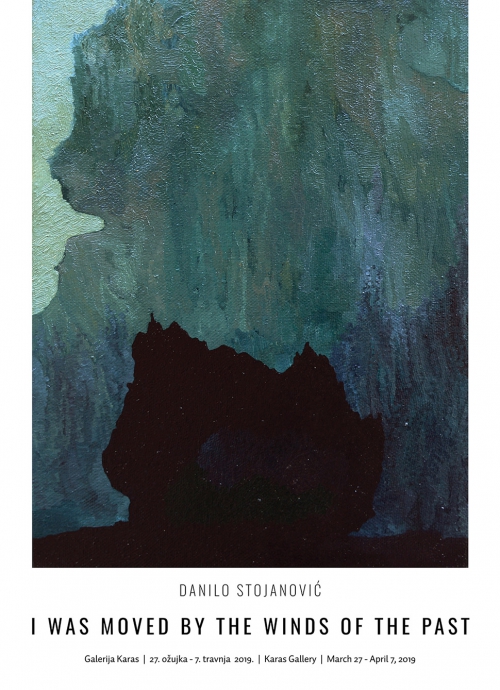
DANILO STOJANOVIĆ
I WAS MOVED BY THE WINDS OF THE PAST
Karas Gallery
March 27 – April 7, 2019
20 March 2019
THE 54TH ZAGREB SALON OF VISUAL ARTS
WITHOUT ANESTHESIA
Home of HDLU
March 26 – May 5, 2019

We cordially invite you to the opening of the 54th ZAGREB SALON – WITHOUT ANESTHESIA, according to the curatorial concept of Branka Benčić and Tevž Logar, on March 26, 2019, at 7 pm at the Home of HDLU, Trg žrtava fašizma 16. The exhibition will remain open until May 5, 2019.
During Salon, we prepared guided tours for you every Wednesday and Friday at 3 pm.
Read more about the exhibition HERE.
Within the 54th Zagreb Salon in the Expanded Media Gallery (PM) the Exhibition of Awarded Authors of the 51st Zagreb Salon: Goran Škofić and Vlasta Žanić – From the Other Side, will be opened. According to the decision of the Award jury both Goran Škofić, for the work On the beach and Vlasta Žanić, for the work Right to vote, won two equal Grand Prix prizes of the 51st Zagreb Salon.
Read more about the exhibition HERE.

TICKETS:
20 kn citizens
10 kn students and retirees
10 kn groups (over 5 persons, fare per person)
Free for regular members of Croatian Association of Artists, AICA, ICOM, Croatian Society of Art Historians and Croatian Journalists’ Association, as well as students of the Academy of Fine Arts and Art History at the Faculty of Humanities and Social Sciences, upon presentation of valid documents.
Tickets are sold at the Croatian Association of Artists box office, during the opening hours of the exhibition.
WORKING HOURS PRSTEN GALLERY, BAČVA GALLERY AND PM GALLERY (Home of HDLU)
Wednesday – Friday: 11am – 7pm h
Saturday and Sunday 10am – 6pm h
Mondays, Tuesdays and holidays (April, 21 (Easter)) closed
19 March 2019
EXHIBITION OF THE AWARDED ARTISTS OF THE 51ST ZAGREB SALON: VLASTA ŽANIĆ AND GORAN ŠKOFIĆ ‘’FROM THE OTHER SIDE’’
PM Gallery
March 26 – May 5, 2019
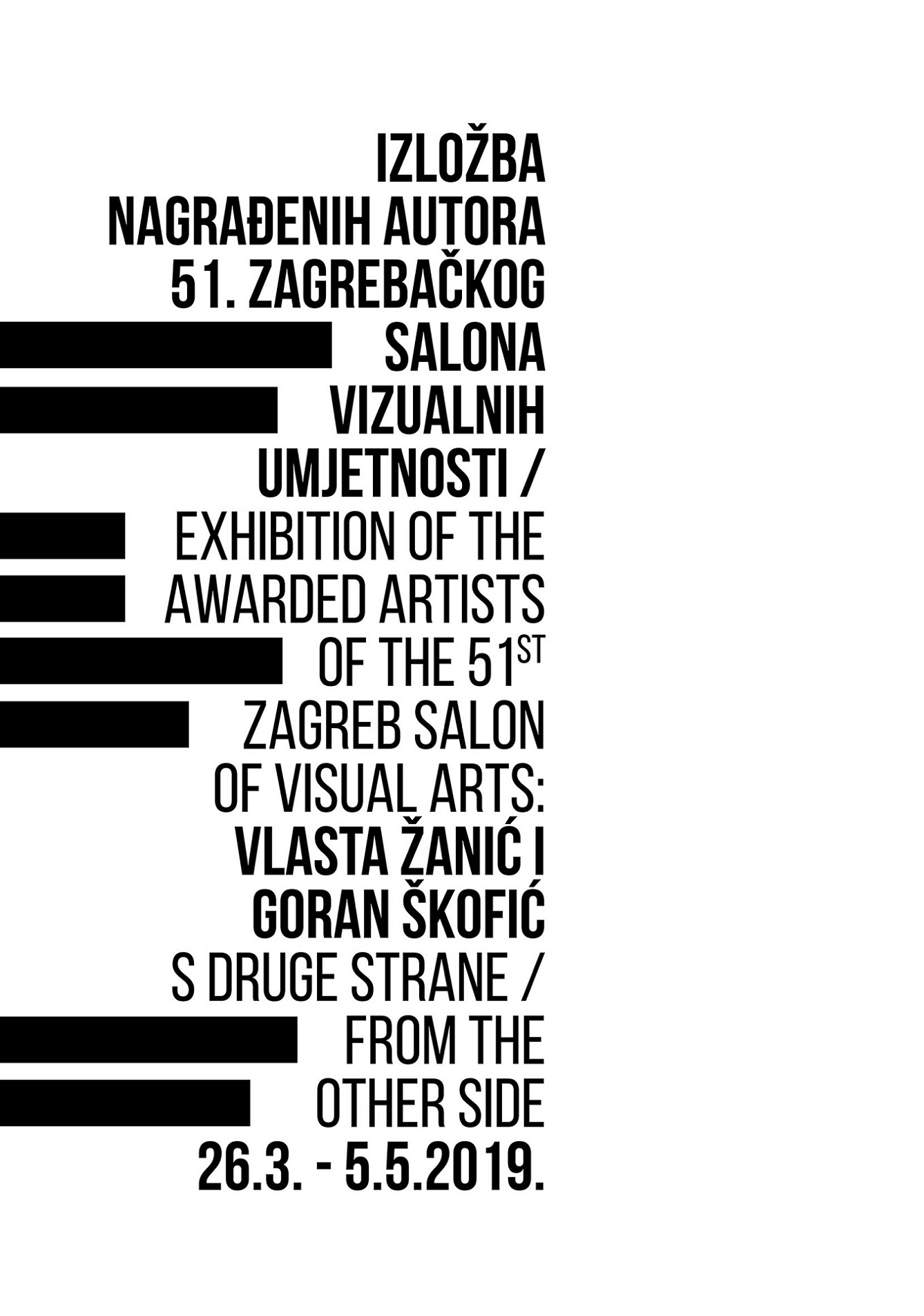
In the frame of the 54th Zagreb Salon, Croatian Association of fine artis will present Exhibition of the Awarded Artists of the 51st Zagreb Salon: Vlasta Žanić and Goran Škofić ‘’From The Other Side’’. Exhibition will take a place in PM Gallery (Extended Media Gallery), starting on Tuesday, March 26 at 8.15pm.
12 March 2019
THE 54TH ZAGREB SALON OF VISUAL ARTS
WITHOUT ANESTHESIA
Home of HDLU
March 26 – May 5, 2019

the 54th ZAGREB SALON – WITHOUT ANESTHESIA, according to the curatorial concept of Branka Benčić and Tevž Logar, will be opened on Tuesday, March 26, 2019, at 7pm at the Home of HDLU, Trg žrtava fašizma 16. The exhibition will remain open until May 5, 2019.
CONCEPT:
The proposal of the curator concept of the 54th Zagreb Salon starts with several assumptions and interests, which it tries to gather within an exhibition that is formed as an existing and recognizable salon format, with the intention of presenting recent artistic production and considering the contexts in which artists work. Considering the background and perspective of the Zagreb Salon the curatorial proposal is formed kaleidoscopically, as a reflection of multiple perspectives and positions. On the one hand, with a twenty-year break, we recall the City scapes (1998) Salon, curated by Igor Zabela, on which this exhibition leans, contemplating continuities and discontinuities, opportunities and perspectives, filled and unfulfilled potentials and aspirations, curatorial practices and institutional history of the exhibition. In the light of Igor Zabela’s thinking about the exhibition as a strategy, the exhibition is a global idea, a significant row of procedures and approaches to ensure that the right viewer sees artwork in the right way. Speaking about this, also the exhibition project Without Anesthesia, which in its internal logic does not address the general problems of presentation, already contemplates the relationships that arise between works of art, institutions and the public.
(…) Formally, the exhibition is developing on the one hand as a generational project, gathering works by mostly Croatian artists who are positioned in a dialogue with generationally close artists from the cultural space of the former SFRY and the international context, finding loose or distant connections and relationships. The Salon thus reflects the tradition of Zagreb as a place that has been included in the international context since the 1960s as a meeting place for artists, critics and institutions. This is the idea that has been inscribed into today´s curatorial practices. The exhibition aims to explore and gather art practices that focus on opportunities, breaks, transformations, failures, and insecurities in relation to contemporary cultural practices in the social and institutional context. Certain metanarratives evolve as a reflection on the format of the exhibition itself, its context, as an attempt to reposition the Zagreb Salon, and it is discursively thought through both through exhibition and the conversations within the side program.
(…) Thought as a space without sharp edges, the 54th Zagreb Salon entitled Without Anesthesia, focuses on the social conditioning of aesthetic and conceptual assumptions, the motivation of the artist. The exhibition explores tensions and fractures within dominant and invisible narratives, questions of uncertainty, tensions or collapses, of space and time, as a places of inscriptions of fractures or potentials. The exhibition and series of events in the side program do not want to be another manifestation “frozen in time”, but wants to show the possibility of constant development within the system of contemporary art, which unconditionally needs to establish a relation to social facts.
(…) In order to articulate some of the formed places of interest, we accepted dialogue as a methodology, deciding on collaborative curatorial work as a dialogue, leaning our dialogue on the multitude of artistic positions.
Branka Benčić and Tevž Logar
ARTISTS:
Marija Ančić, Željka Blakšić AKA Gita Blak, Ben Cain, Jasmina Cibic, Nemanja Cvijanović, Karla Čurčinski, Matija Debeljuh, Igor Eškinja, Fokus Grupa, Martina Grlić, Igor Grubić, Tina Gverović, Siniša Ilić, Paulina Jazvić, Jelena Jureša, Petar Katavić, Kristina Marić, Ines Matijević, Damir Očko, Petra Orbanić, Jelena Petric, Renata Poljak, Viktor Popović, Jasenko Rasol, Lala Raščić, Davor Sanvincenti, Marko Tadić, Nora Turato, Katarina Zdjelar.
Side program coming soon!

Within the 54th Zagreb Salon in the Expanded Media Gallery (PM) the Exhibition of Awarded Authors of the 51st Zagreb Salon: Goran Škofić and Vlasta Žanić – From the Other Side, will be opened. According to the decision of the Award jury both Goran Škofić, for the work On the beach and Vlasta Žanić, for the work Right to vote, won two equal Grand Prix prizes of the 51st Zagreb Salon.

TICKETS:
20 kn citizens
10 kn students and retirees
10 kn groups (over 5 persons, fare per person)
Free for regular members of Croatian Association of Artists, AICA, ICOM, Croatian Society of Art Historians and Croatian Journalists’ Association, as well as students of the Academy of Fine Arts and Art History at the Faculty of Humanities and Social Sciences, upon presentation of valid documents.
Tickets are sold at the Croatian Association of Artists box office, during the opening hours of the exhibition.
26 February 2019
MARIJA MATIĆ
THE VOICE OF THE LINE COMES FROM THE SOUL
Karas Gallery
March 5 – March 17, 2019

MEŠTROVIĆ PAVILION CLOSED DUE TO RENOVATION
INFORMATION FOR VISITORS


Web Hosting


