
Category: Events
25 February 2019
MARIJANA STANIĆ
SWEET LIFE
Bačva Gallery, Home of HDLU
February 28 – March 13, 2019.

Opening of the exhibition: Thursday, February 28 at 7 pm at the Bačva Gallery (Home of HDLU)
Exhibition Sweet Life, by Marijana Stanić, will be opened on Thursday, February 28 at 7 pm at the Bačva Gallery (Home of HDLU). The exhibition is accompanied by a performance.
The performance can be seen for 3 days: February 28 (7 pm) / March 1 (5 pm) / March 2 (5 pm).
After that, video documentation of the performance can be seen in Bačva Gallery until the end of the exhibition.
“In fact, we understand girlhood as a space of pleasure and opportunity just as much as a place of coercion. And I do not know why we can not embrace it and accept it, find a way to talk about the negative aspects of this experience while enjoying its positive sides,” said Catherine Driscoll, a feminist theoretician in conversation with Barbar Gregg for Vox Feminne.[1] This sentence, with which Driscoll calls for understanding of the girlhood, a broad and complex field of cultural and social implications that characterize the life of young girls, on the one hand, exposed to brutal commodification and manipulation, and on the other, to social minorization, summarizes, precisely, as if it was an artist’s statement, key aspects of the exhibition Sweet Life, by Marijana Stanić. Composed of three, meaningfully interwoven, and somewhat identical, chapters of the girl’s dreams of love, which are rounded off by the show about an ideal marriage – wedding cake, bride figure, and eternal love – this exhibition emphasizes constitutive nods of discourse about girlhood, deformed in controversy between intimate expectations, popular culture, legislation, economics, social norms, sexuality, political subjectivity, and ultimately generational divisions.
The perfect life form girls’ fantasies is represented at the exhibition with the circular infinite white space of the Bačva Gallery, repeated in loop audio recordings of happy endings from fairy tales, by stringing infinite scenes of gorgeous wedding cakes, decorated with flowers and fruit garlands and by multiplying bridal figures in the space. However, this is not about one-sided or literal transposition of girls’ fantasies. Each segment of the work, in fact, suffered a certain intervention by which the author subverted the initial seduction. In an endless enumeration of cakes, for example, they take on absurd proportions, and creams and sugar ornaments cause nausea. The happy endings of fairy-tales are reading stuttering children, who have just learned to read, and in this difficult passage through the text, the life culmination of princesses and beauties (which are fairly active and effective during a fairy tale) is revealed as a definitive fixation of the new passive position: they are chosen, taken away, kissed and are happy for the rest of their life. The brides are, however, alive. They are beautiful and fragile in their exposure, all dressed up and almost immobile, with discrete choreography performing in three-hour performance, with their eyes closed. In such a constellation, where there is no boundary between the audience and the performer’s space, additionally burdened with the relationship between the one who looks and the one who is watched, the audience, drawn into the intimate space of the girls, becomes the voyeur, participating, even if unintentionally, in their objectification. The discomfort of the viewer is, in fact, a provocation, a call for understanding, and responsibility in the society we build.
From preface, written by Irena Bekić
[1] „Catherine Driscoll: Djevojaštvo je prostor užitka i mogućnosti jednako koliko i mjesto prinude“// https://voxfeminae.net/kultura/catherine-driscoll-djevojastvo-je-prostor-uzitka-i-mogucnosti-jednako-koliko-i-mjesto-prinude/ (21.2.2019)
Organizer:

Supported by:


WORKING HOURS:
Monday to Friday: 11.00 AM – 7.00 PM
Saturday and Sunday: 10.00 AM – 18.00 PM
The exhibition will remain open until March 13, 2019
19 February 2019
WHAT DO YOU MEAN – YOU LOVE ANIMALS?
Ivana Filip
PM Gallery
Feb 25 – Mar 13, 2019
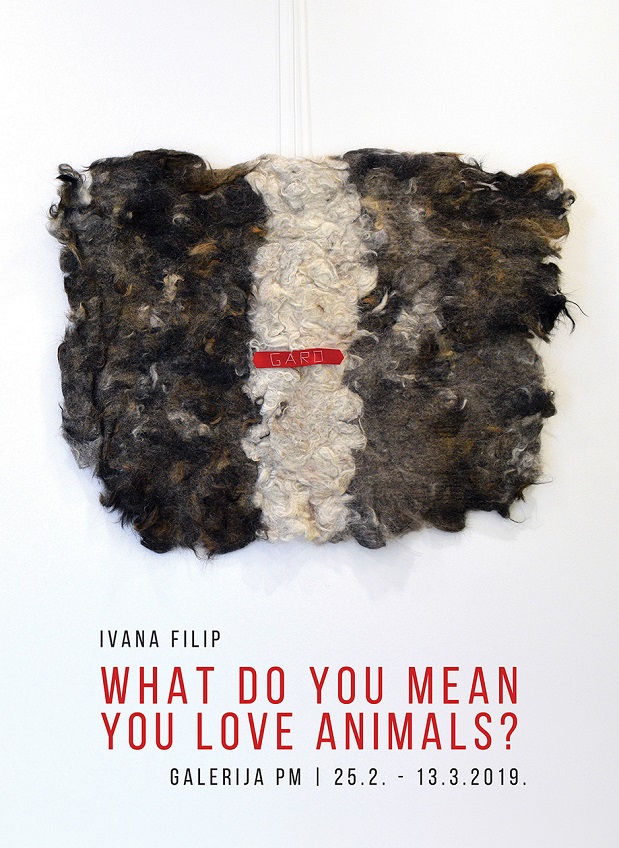
Exhibition opening: Monday, February 25 at 7 pm at the Home of HDLU
18 February 2019
Henryk Tomaszewski
The Graphic Poet
Prsten Gallery
February 25 – March 13, 2019

The retrospective exhibition of Henryk Tomaszewski opens on Monday, February 25, 2018 at 7pm at the Prsten Gallery of the Home of the Croatian Association of Artists.
30 January 2019
PETAR VRANJKOVIĆ
WHANAU
Karas Gallery
February 5 –February 17 , 2019

Opening of the exhibition: Tuesday, February 5 at 7 pm at the Karas Gallery
Exhibition Whanau, by Petar Vranjković, will be opened on Tuesday, February 5 at 7 pm at the Karas Gallery (Zvonimirova 58).
“On yellowed black and white photography, scratched at places, we see a young man and a girl. The young man is hugging a girl with one hand, holding hers with both hands. They both look at the camera. He is smiling, and she is serious, with relentless look pointed straight into the camera. Click. The moment passed. (…)
Part of the family history that physically emerges from the private sphere is actually hidden. What the author, however, reveals through his work is his own emotional relationship to the heritage he found. The photos that were previously in the boxes are carefully placed in the frames, and their transformation from just being seen to becoming a part of the emotional intergenerational exchange ends with the transfer of the three selected scenes from the photo to the unbleached linen in lithography. By juxtaposing an old piece of cloth found in his grandmother’s home to the wedding photography of his grandparents, it is like he adds himself to this photo and gives honor to those whose experiences have shaped him.”
ABOUT THE ARTIST
Petar Vranjković, born 15. 11. 1997, is a young transmedial artist who uses photography and archive as base factors of his research. He attends the Academy of Fine Arts in Zagreb and studies on the Department of Graphics. He participated in multiple solo and group exhibitions both in Croatia and abroad.


Supported by:
Working hours:
Wednesday – Friday: 3 pm – 8 pm | Saturday and Sunday: 10 am to 1 pm
Mondays, Tuesdays and holidays: closed.
The exhibition will remain open until February 17, 2019
17 January 2019
CRTOVLJA
Marcel Bačić
PM Gallery
Jan 24 – Feb 17, 2019
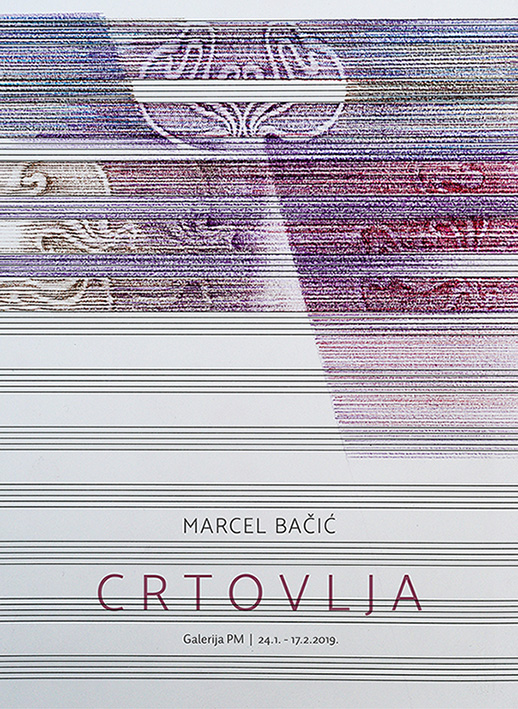
Exhibition opening: Thursday, January 24 at 7 pm at the Home of HDLU
17 January 2019
INTO THE MOUNTAINS
BAČVA GALLERY
HOME OF HDLU
January 24 – February 17, 2019

The opening of the exhibition: Thursday, January 24 at 7 pm at the Home of HDLU
Exhibition Into the Mountains will be opened on Thursday, January 24 at 7 pm at the Home of HDLU (Trg žrtava fašizma 16, Zagreb). At 7.30 pm there will be a performance by Nicola Genovese, called When S.H.T.F..
The exhibition at the Bačva Gallery is the next stage of the project Into the mountains, which consists of a conference, a group residence on Velebit mountain and residences in the Swiss and Austrian Alps. The project ends with two exhibitions at the Shed im Eisenwerk Gallery and in the Bačva Gallery of Home of HDLU.

Foto by: Vanja Babić
Within the first stage of the project, the group of artists (Vanja Babić, Nicola Genovese, Ivana Pipal, Jovana Popić and Andri Stadler), curators (Katja Baumhoff, Bojan Mucko and Josip Zanki) and students of the Academy of Fine Arts in Zagreb (Ivan Barun and Katrin Radovani), The Faculty of Humanities and Social Sciences in Zagreb (Maja Flajsig) and the University of Zadar (Aleksandar Tomaš) stayed on the southern part of Velebit (partly in the Paklenica National Park and on the mountain tops), conducting contemporary art research in situ in the mountainous context.
On the last day of the project on Velebit, on June 17, 2018, a professional conference was held in cooperation with the The Faculty of Humanities and Social Sciences in Zagreb and the Department of Anthropology and Ethnology of the University of Zadar. Besides our students and artists, our distinguished ethnologist and anthropologist, Mario Katić, P.h.D., held a speech on the conference. Nevena Škrbić Alempijević, P.h.D. and Jelena Kupsjak participated also.

Mario Katić, P. h. D., a professional conference held in Starigrad; Foto by: Martina Miholić
From September 8 till October 9, 2019, an exhibition titled Withdraw – Into the Mountains at the Shed im Eisenwerk Gallery in Frauenfeld, Switzerland, as a result of a seven-day research residency in the Gallery.

Exhibition Withdraw – Into the Mountains, Gallery Shed im Eisenwerk, Frauenfeld (Switzerland); Foto by: Almira Medarić
The project through residencies on Velebit, Austrian Alps and Swiss Alps practically and artistically analysises concepts such as: living utopia, free shelters, Joseph Beuy’s backpack, walks as a performative and artistic instrument, mountain as a life style, mountain as an existential minimum, free and working time relationship and landscape as an images, experiences and public good. Also, the project tries to answer the question of how today’s artistic, precarious work escapistically, utopistically, dystopically or mimicrically fits into everyday mountain life.
Velebit, emptied by the migrations of the second half of the 20th century, has historically been characterized by transhumance cattle-breeding (seasonal movements of people and livestock between summer and winter pastures at different altitudes). It is interesting to compare the legacy of the coastal ethnic group Bunjevci in today’s context of the rapid disappearance of of cattle-breeding on Velebit and Swiss, alpine examples of “conservation” of traditional cattle-breeding models – comparable to the concept of a living open-air museum.
Unlike Velebit, which is interlaced with free shelters for hikers, staying in Austrian and Swiss mountain lodges is part of elite tourism. Throughout history, Velebit was the place where rebels like hajduks, uskoks, and loners, who seek escape from civilization, stayed. Therefore, the utopian aspect of the mountain is present even today as a model of escape into the imagined Utopia (to paraphrase Hakim Bey – the mythical Croatan).
Artists:
Vanja Babić, Nicola Genovese, Luise Kloos, Esther Mathis, Ivana Pipal, Jovana Popić, Andri Stadler, participative work: Ivan Barun, Katrin Radovani i Josip Zanki
Curators:
Katja Baumhoff, Bojan Mucko i Josip Zanki
Side program:
Katja Baumhoff, P.h.D. from The Oskar Reinhart Collection ‘Am Römerholz’ in Winterthur, will host a lecture on “Collecting Art in Winterthur – a Town Full of Renoirs, Cézannes, Cranachs, Caspar David Friedrichs …” on Friday, January 25, 2019 at 11 am in the Grand Hall, at the Academy of Fine Arts in Zagreb.Katja Baumhoff, Dr. phil. received her M.A. and Ph.D. in Art History and American Studies from Heinrich Heine University Düsseldorf, Germany. She has been studying at the universities of Naples, Italy and Reading, UK and has been a visiting scholar at Yale University, New Haven, US, focusing on American modernist art.
Currently, she works as an art historian, author, and curator in Winterthur, Switzerland. She is research associate at the Collection Oskar Reinhart “Am Römerholz”, Winterthur, an institute of the Swiss federal office of culture. She is also the artistic director of the Shed im Eisenwerk, Frauenfeld. As a curator of contemporary art, her programmatic points of interest are current social and sociopolitical tendencies as well as material aesthetics.
Currently, she works as an art historian, author, and curator in Winterthur, Switzerland. She is research associate at the Collection Oskar Reinhart “Am Römerholz”, Winterthur, an institute of the Swiss federal office of culture. She is also the artistic director of the Shed im Eisenwerk, Frauenfeld. As a curator of contemporary art, her programmatic points of interest are current social and sociopolitical tendencies as well as material aesthetics.
Organizers:


Supported by:


WORKING HOURS:
Wednesday to Friday: 11.00 AM – 7.00 PM
Saturday and Sunday: 10.00 AM – 18.00 PM
Closed on Mondays, Tuesdays and holidays.
Working hours during the Long Night of Museums, on February 1, will be from 11 am till 1 am.
At 6 and 7 pm there will be a guided tour through the exhibition held by curators Josip Zanki and Bojan Mucko.
The exhibition will remain open until February 17, 2019
15 January 2019
YICCA 2018
International Contest of Contemporary Art
Final exhibition – opening
Prsten Gallery
24 January -17 February 2019
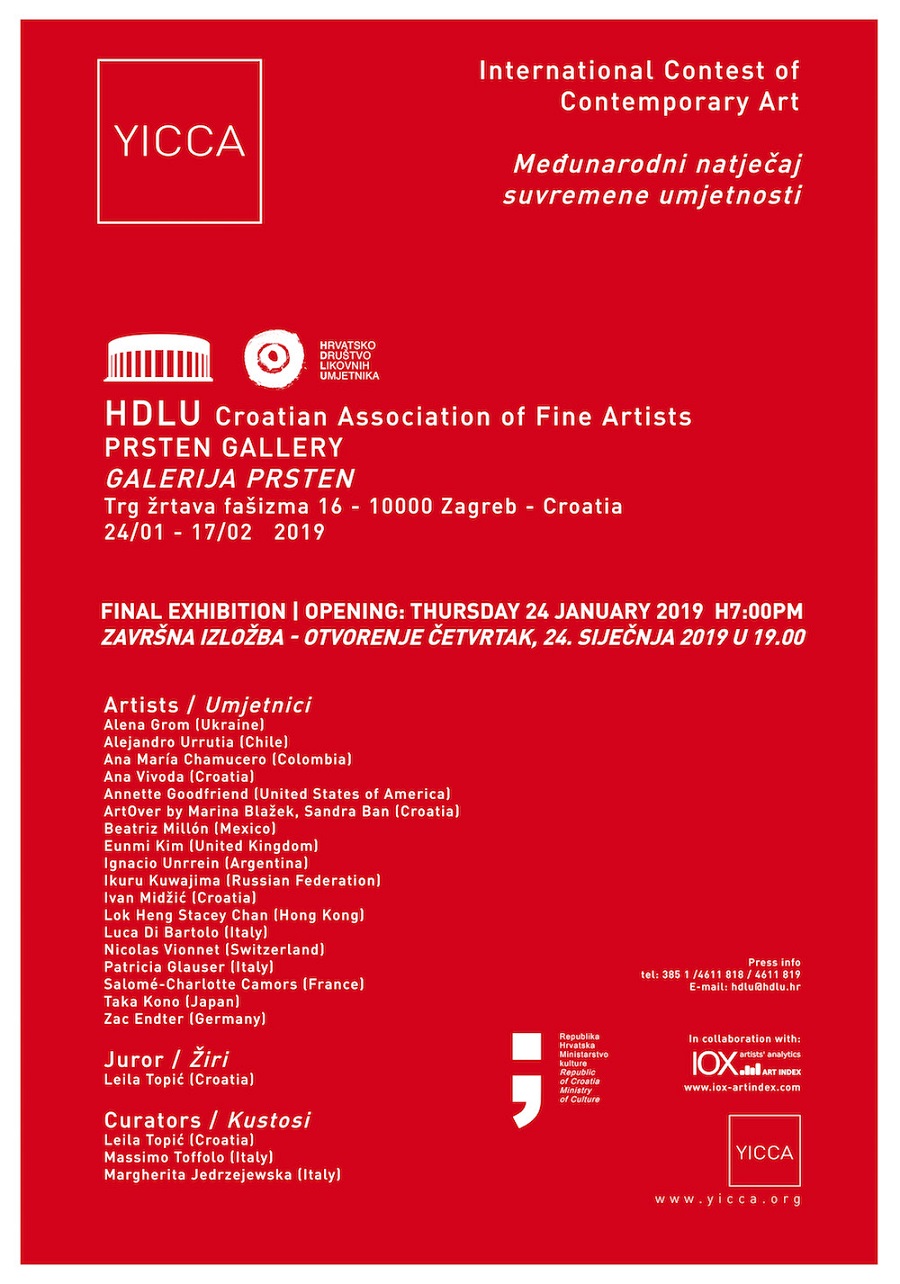
Exhibition opening: Thursday, 24 January 2019, 7:00pm
We are pleased to present the “YICCA 2018” final exhibition.
The exhibition presents works by 18 international artists: Alena Grom (Ukraine), Alejandro Urrutia (Chile), Ana María Chamucero (Colombia), Ana Vivoda (Croatia), Annette Goodfriend (United States of America), ArtOver by Marina Blažek, Sandra Ban (Croatia), Beatriz Millón (Mexico), Eunmi Kim (United Kingdom), Ignacio Unrrein (Argentina), Ikuru Kuwajima (Russian Federation), Ivan Midžić (Croatia), Lok Heng Stacey Chan (Hong Kong), Luca Di Bartolo (Italy), Nicolas Vionnet (Switzerland), Patricia Glauser (Italy), Salomé-Charlotte Camors (France), Taka Kono (Japan), Zac Endter (Germany).
Each artist, through different mediums, investigates the multi-facet perspectives and shades of the human being, displaying new innovative concepts. The works of the various artists included in this exhibition resonate with major contemporary cultural, economic and political realities experienced as part of everyday lives and across the globe.
This exhibition traces the emergent contemporary art’s current trends, spanning different generations, their practices traversing the disciplines of contemporary artistic
creation.
The juror:
Leila Topić (senior curator at Zagreb Museum of Contemporary art)
The curators:
Leila Topić (main curator of Yicca 2018, Croatia)
Massimo Toffolo (main curator of Yicca, Italy)
Margherita Jedrzejewska (curator of Yicca, Italy/Poland)
Organizer:
Partner:
Supported by:
Working hours:
Wednesday – Friday: 3 pm – 8 pm | Saturday and Sunday: 10 am to 1 pm
Mondays, Tuesdays and holidays: closed.
MEŠTROVIĆ PAVILION CLOSED DUE TO RENOVATION
INFORMATION FOR VISITORS


Web Hosting


