
Category: Events
26 November 2014
Tomislav Čeranić
L’HORIZON CHIMERIQUE
November 18 – December 7, 2014
RING GALLERY
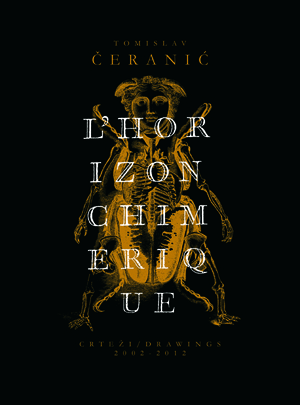
Whereas in the majority of artists drawing has a preparatory or accompanying status, in Tomislav Čeranić’s work it holds the status of a finished artistic result, autonomous sculptural organism, map that registers and brings to light the flow of labyrinthine path of the author’s extremely subjective imagination. For decades now Čeranić has been proving to the anxious modern world, in attractive and artistically compelling ways, that drawing can justifiably compete with other modern methods of artistic expression. Establishing drawing as independent and completely finished work, an autonomous discipline and independent creation, this artist of delicate and refined spirit does not decide to refer to the perceived reality, but instead he opts for escapism as the principle of detachment from the material interpretation of reality, for the creation of fictional worlds, purely fictional construction of images and shapes. In Čeranić’s work the utopianism of fictional reality, created with unique and virtuoso-drawings, segmented in interesting and always and completely, and in all aspects articulated cycles, comes before the message that the other media – when referring to reality – send to the observer in a clumsy way. Unlike the – old and new – figuration we usually encounter in the work of the local environment, his figuration is completely deprived of eschatological messages, and the only thing he wants to achieve is to provide himself with the opportunity for free self-disclosure in the conjunction of erudition and poetry, in a unique version of visual “schizotext“. Therefore, there are no artists in Croatia who are similar to him in style or language. Such artist remains an independent individual who speaks in the first person. He is more interested in using the language of autonomous sculptural logic and citation – it is like he is stateless, he remains enclosed in his own small intimate fictional world, but familiar, open and attractive to the visual sensibility of the present observer, who is thus easily motivated to dive into the meditative and subliminal space behind and below the image.(From the foreword Drawing as «schizotext» of Ivica Župan )
CURATOR: Vinko Srhoj
Tomislav Čeranić was born in 1961 in Šibenik. He graduated in Art History at the Faculty of Philosophy in Belgrade.
www.tomislav-ceranic.net
RING Gallery
Croatian Association of Fine Artists
Trg žrtava fašizma 16, 10000 Zagreb, Croatia
Working hours:
Wednesday to Friday 11am – 7pm
Saturday and Sunday 10am – 6pm.
Monday, Tuesday and holidays – closed


17 November 2014
Vlatko Vincek
ANTI
November 18 – November 27, 2014
Opening of the exhibition on 18th of November at 7:30 pm
16 October 2014
MARJANA KRAJAČ
VARIATIONS ON SENSITIVE
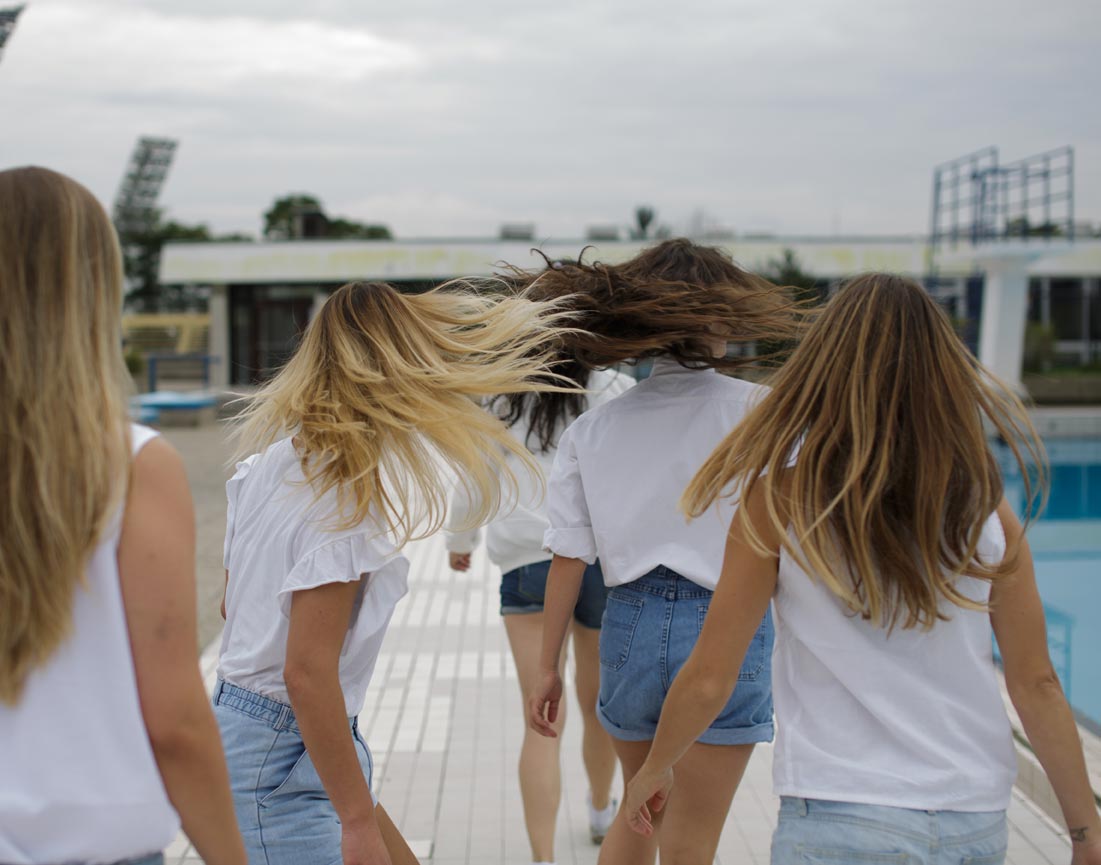
The new work by choreographer Marjana Krajač is a three-hour performance at the Mestrovic Pavilion / Dom HDLU in Zagreb, which will be premiered on 18th of October 2014 starting at 14 h, with performances on 19th, 20th, 21st and 22nd of October also starting at 14 h.
This simultaneously complex and fragile consideration of the nature of dance, whose building material is just enough present in order to irrevocably dissapear,
is extensive, yet minimalistic dance session between sound and space.
Performed by dance artists Lana Hosni, Irena Mikec, Katarina Rilović, Irena Tomašić and Mia Zalukar, this long dance work invites you to spend time with it, coming gradually into the layers of its texture.
In her last works, Marjana Krajač embarked on a complex mission of revoking the very substance of a dance medium, exposing its own ontology and deconstructed historicity. In such intervention, that deals with the very nature of dance – Spinoza would call it natura naturata, modes and conditions of substance can seek its cause only in themselves. To dance a dance, means then also that the very dance must go through the experience itself. This suggests that something beyond the experiential horizon of dance can only be a projection of its function but not the dance itself. In such framework of interest, Marjana Krajač and five dance artists are asking relevant questions and opening up the space of joint consideration of metaphysical commitments and added meanings. What inhabits a dance event becomes part of its foundation.
Moving away from short-term effects of watching, this work calls for flexibility of time and experiential notion of a performance. VARIATIONS ON SENSITIVE are proposing this work as a community experience and the group experience, in any case, something that we share with others via watching. The Other, which is the mirror of what occurs, becomes important for our understanding of dance as an art of transfer. Transfer through the other and the friction on the other becomes the only area in which dance can construct some type of memory to itself. In this sense, the other is at the same time a witness and a participant.
The work was created in cooperation and residencies at Uferstudios / Tanzfabrik Berlin (Germany), Santarcangelo dei Teatri (Italy) and the Zagreb Dance Centre.
The work was realized with the support of the City of Zagreb, Croatian Ministry of Culture, Zagreb Dance Centre, Croatian Institute for Movement and Dance and the Croatian Association of Artists.
==========================
Tickets
Admission to the premiere on October 18th is by invitation.
For 19, 20, 21 and 22 October tickets can be purchased directly before the performance at the ticket office at the entrance of Mestrovic Pavilion / Dom HDLU. The ticket office opens 1 hour before the performance.
HDLU
Trg žrtava fašizma 16, 10000 Zagreb, Croatia
tel: 01 / 4611-818 / 4611-819 (weekdays from 10 to 14 hours)
E-mail: hdlu@hdlu.hr
Web: www.hdlu.hr
SODABERG KOREOGRAFSKI LABORATORIJ
19 September 2014
 THOMAS RENTMEISTER – CONSIDERING THE MATTER
24.09. – 12.10.2014.
Opening on Wednesday, September 24th 2014 at 7.30 pm
Gallery Bačva
Trg žrtava fašizma 16
10000 Zagreb
Photograph by Bernd Borchardt
‘CONSIDERING THE MATTER’
(Materiality and Play in the Work of Thomas Rentmeister)
The essence of Thomas Rentmeister’s work is the imagination, materiality and play. Man, as Johann Huizinga’s famous book long ago observed, is by his culture forming nature homo ludens (‘man the player’), and as a result over time has become a master manipulator of the material world. It is clear that playing offers an accumulation of practices that leads through repetition to an extension of new forms of originality and innovation. Hence the title of this exhibition is intended to be simultaneously playful and intellectual, that is to say the artist Thomas Rentmeister considers his use of materials both as tactile resources and as food for thought. While the materials of his artistic practice are invariably mass-produced and easily accessible or familiar to the viewer, they nonetheless form a unique vocabulary of personal transformation. In and through an imaginative and sensory compilation of expressive material affects that Rentmeister shapes an admixture of minimalist referent and post-minimal disequilibrium. As a result he is able to invest his works with a unique sense of wit and wistfulness: that is he reveals a double-edged sense of formal propriety through his compositional sculpture-making practice while evoking at the same time highly textured informal feelings of vague or regretful longing.
26 June 2014
Politicization of Friendship
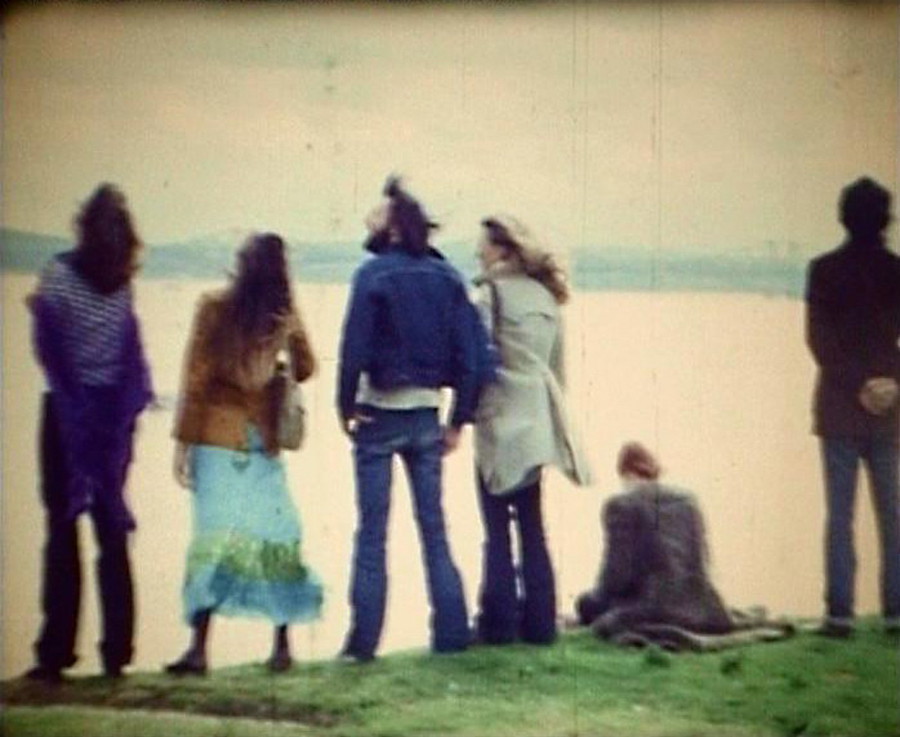
Zoran Popović: Pretty Good Edinburgh and Surrounding Area, 1973 (film 8 mm, color, silent, 11’20)
Courtesy: Zoran Popović
Roberto Barandalla & Darío Schvarzstein, Jože Barši, The Beehive Design Collective, Ivan Cardoso, Juan Downey, La Escuela de Valparaíso, GALCHI (Galeria Chilena), Group Material, Group of Six Artists, Minna Henriksson, Roberto Jacoby, KURS (Miloš Miletić & Mirjana Radovanović), Madness in the Eighties: Anti-Psychiatry Movement in Slovenia, Manga Rosa, Roberto Mardones, Tina Modotti: Farewell to Photography, Andrei Monastirsky (Collective Actions), Museo de la Solidaridad / Museum of Solidarity, Santiago, Chile, The OHO Group, THE PLAY, Zoran Popović, The Real Estate Show, Benet Rossell, Škart, Josip Vaništa (Gorgona), Yugoslav Surrealists: Politics of the Impossible
1 July – 28 September 2014
Museum of Contemporary Art Metelkova, Maistrova 3
Curator: Bojana Piškur
Co-curators: Isabel García Pérez de Arce, André Mesquita
Special projects curated by: Miklavž Komelj, Branka Stipančić
You are cordially invited to the exhibition opening onTuesday, 1 July 2014 at 8 p.m. at the Museum of Contemporary Art Metelkova, Maistrova 3.
In the history of philosophy as well as theory of art there exists a variety of works based on the idea of friendship. The core of present interest in friendship goes beyond friendship as mere closeness, affinity, affection or some consensus of opinion. It implies a broader political dimension and consequently a certain tension and malaise.
The exhibition itself evolved from the premises of so-called participatory art of Eastern Europe and Latin America, which are here brought to a significantly different level. The exhibition Politicization of Friendshiptherefore attempts to encompass certain aspects of “participation”, for instance collective artistic production, solidarity, interaction and collaboration between artists in different parts of the world where the art system was not only underdeveloped, but also completely indifferent towards alternative artistic practices. Some of the typical characteristics of Eastern European and Latin American spaces and their understanding of collectivity and collaboration include informal alternative art spaces, apart-art, art collectives, collective creativity, self-organizing, “self-historicization,” etc.
However, our point of departure is not the history of theater or performance art, where theoreticians typically tend to locate the beginnings of participatory art, but primarily ruptures in various areas of knowledge, or “the new politics of knowledge”, that have occurred since the 1960s. Such ruptures produced different discourses – not only the discourse on madness, sexuality, history and a variety of scientific discourses, but also the discourse on art. They all derive from an attempt to dispense with the conventional habits of mind and received ideas in each established area, or in other words, from the need to uncover the relations between knowledge and power.
The exhibition presents works by artists, art collectives and movements that stem from the following questions: What can friendship achieve? What shifts can occur, in both artistic-formal and political terms, if friendship begins to create new ways of interpersonal relating and new structures of being? What is at issue is not just the political potential of an artwork or its emancipation from the representational regime, but politicization as desire, which “deploy[s] its forces within the political domain and grow[s] more intense in the process of overturning the established order.” In short, desire as the driving force of exploration, which surfaces at some fundamental encounter at the junction of politics, art, philosophy, etc.
Friendship can’t simply be equated with collective spirit and collective work; it is a form of emancipation, not in the sense of political correctness, consensus or search for some universal truth, but as a constant discovering of what we are and what we become in the processes of friendship. These questions are both essentially political, calling for a decision that does not come easily, hence demanding a significantly different engagement in the here and now.
The day after the opening, on July 2, at 6 p.m., you are invited to attend a talk with participating artists, moderated by Bojana Piškur and Tjaša Pogačar Podgornik (in English). Accompanying the exhibition there is a program of lectures and talks, workshops, and screening of buddy film at the Slovenska Kinoteka.
The exhibition is accompanied by a catalogue designed by Škart.
The exhibition is supported by the Ministry of Culture of the Republic of Slovenia.
06 May 2014
 Seven about the reality
09.05. – 22.05.2014
Gallery Konduktorownia
Czestochowa, Poland
www.konduktorownia.eu
Seven about the reality
09.05. – 22.05.2014
Gallery Konduktorownia
Czestochowa, Poland
www.konduktorownia.eu
Exhibition of seven Croatian mid- and young generation artists presents seven different and specific artistic approaches that tell seven stories about present and reality, stories that get close to each other at certain points. Through their visions, interpretations of the media and their own constructed way of perception, they present certain issues to the observer. By using different media approaches they analyze almost all the key aspects of our present, situations we think about on a daily basis, at conscious and subconscious levels – examining ourselves and our own personality, questioning and exploring the details of environment which surrounds us on a day-to-day basis, by setting these details on a new aesthetic level, and above all analyzing social statuses and events, norms and conventions, which are products of new times.
By the balanced power and sensibility Mia Orsag brings insightful work which attempts to examine and analyze some of the key metaphysical questions – life, relationship, identity.
Her sculpture 2/4 presents the mathematical formulation, the redistribution of ”safe and sound”, and of what is subject to change due to the impact of a number of everyday factors.
Two quarters are the positive energy, stability and eternal brace, while the remaining two quarters are incomplete, undefined and ready for the changes that the future brings and maybe at some point circumstances allow the separate halves become whole.
Patinated drawings of spaces and figures, which are here and at the same point they start to disappear, from the series No One No Where, are the result of her preoccupation with the present and the key issues; identity, existence and change, that she wants to share with the observer.
The very process of scribbling, drawing, erasing and scratching is very easily associated with time-consuming and painstaking process of knowing the world and ourselves, moreover the result of the search often remains vague and undefined. Mia’s drawings are trying to investigate exactly these extreme fields of knowledge and existence.
Works of Mirjana Vodopija, from the series Breath and Herbs are the result of research of ordinary, everyday elements of the environment, especially unsightly vegetation, which due to the play of light takes on a new dimension, bringing into question the limit of existence. A great source of inspiration for her work and research, Mirjana Vodopija finds in nature and through her experiments in various medias, such as graphics, drawing, photograph or object, she is able to successfully articulate her ideas and gives the opportunity to the observers, by broadening their horizons and possibilities of perception. Quite common elements appear in new forms and take on new characteristics. With the help of photography, the artist presents to us already naturally and clearly defined objects, which by the help of the limited light moments she transformed into her final idea – the border area where something exists and disappears. Her works as a result of patient research, conscious and unconscious moments where ideas develop, educate the view and raise issues about the infinite possibilities of perceiving the world around us.
Questioning of the border worlds, and her own personality and reality are brought in the works of Marina Fernežir, which she created in the last two years, as part of the cycle ”Alchemy of dreams”.
Marina Fernežir has a specific artistic style, built on the foundations of her conservation and restoration activities.
Through the works in this cycle we follow development of her inner worlds, which are the images blended with elements of reality, but still remained on the border between dreams and reality. It is a combination of concrete and familiar elements in the picture, figures and landscapes, with stylized elements of architecture and unexpected motifs, that allows Marina Fernežir’s paintings to transcend the banality of everyday life scenes. What was at the beginning an exploration of the basic elements of artistic creativity, resulted in a transformation of the motifs into visual language similar to the visions of dream worlds.
Elvis Berton presents works from three different cycles, moving from intimate Istrian porches over the stylized interpretations of the nature and the actual artistic perception of objects in it, to the criticism of today’s ”shifted” society. The work from the series ”Porches”, brings a touch of Istrian atmosphere, setting styled porch in the landscape of great tension, constantly waiting for the relief. Landscapes and plants in Berton’s paintings are styled almost to the limit, tending to represent his personal visions and perceptions of the living nature.
At first seemingly only lovable lemon motif, defined by the artist’s bold and specific visual expression, can be considered as a motive from everyday life, but Berton’s Lemons assume in this case another function – disclosing putridity, acidity and decadence of modern consumerist society.
Artistic tandem Žižić / Kožul directly and clearly present their work, which is based on the relationship between modern art and marketing of high class fashion and luxury industry. They are opening the question of recycling elements and phenomena of the contemporary art in marketing propaganda and what happens when contemporary art appropriates the aesthetic norms and rules of major marketing giants. They question the quality of the products that are on a daily basis served to consumers and the manipulation of advertising campaigns, which has found an ideal breeding ground in today’s time of impersonality of submission, apathy and dullness of modern society. ”Good taste” of the elite representatives of such society has long ago become questionable, and thus the taste of the vast majority of the world – a whole series of ”ordinary” people who often by all means go beyond their possibilities, in order to follow the ”dogma” of aggressive and manipulative marketing.
The works of the young sculptor Vojin Hraste are the excellent continuation of questions that opened Žižić / Kožul, but Hraste turns it to the perception of himself. Twisted perception of his own personality manifests itself in a self-portrait increased by 50 % compared to the natural size, filled with plastic hair, which transforms him beyond recognition, while subtly alluding to the popular ventures of installing silicone implants, which can change (distort) a man from head to toe.
Hraste clearly, directly and literally questions the giant of the film industry, Hollywood, which from day to day imposes a multitude of aesthetic norms and rules, whose correctness and logic is truly questioned just by few people. Entire film and media industry, bring to the individuals countless possibilities of ”correction” of their own personality, behavior, attitude and style, where it becomes clear that very benign is physical, and more worrying is its mental transformation.
Artworks of Tea Hatadi, complete this joint exhibition of seven Croatian artists, who in different ways and by various methods talk about the present and immediate preoccupations.
By specific aesthetic approach, Tea Hatadi seductively attracts us to focus our attention on her work, disclosing clearly and directly her private information, with a defined and specific attitude talks about her position of a contemporary artist, criticizing moments of the struggle for survival while taking her place on the artistic scene.
Contradiction is one of the foundations of Tea’s works, skillfully balancing between the composition of seductive and gentle, and strong, sharp, direct and to a certain extent negative elements.
Tea’s work Censorship of Happiness, clearly articulated artistic achievement, that is visually striking and attractive, brings a look at a relative term of happiness. Her colleagues, artists talk about happiness, which is closely related to their artistic creativity, sometimes it is a spark of happiness that came in an unexpected moment, and sometimes their luck is a result of negative situations. Tea’s censorship comes down to the visual aspect, using silhouettes in the background in sepia tone, draws the viewer to listen to them closely and examine their own perceptions of happiness.
This goes back to the starting point of personal analysis and analysis of abstract philosophical concepts, thus seven stories become the whole.
Sara Čičić
MEŠTROVIĆ PAVILION CLOSED DUE TO RENOVATION
INFORMATION FOR VISITORS


Web Hosting


