
Category: Events
14 April 2014
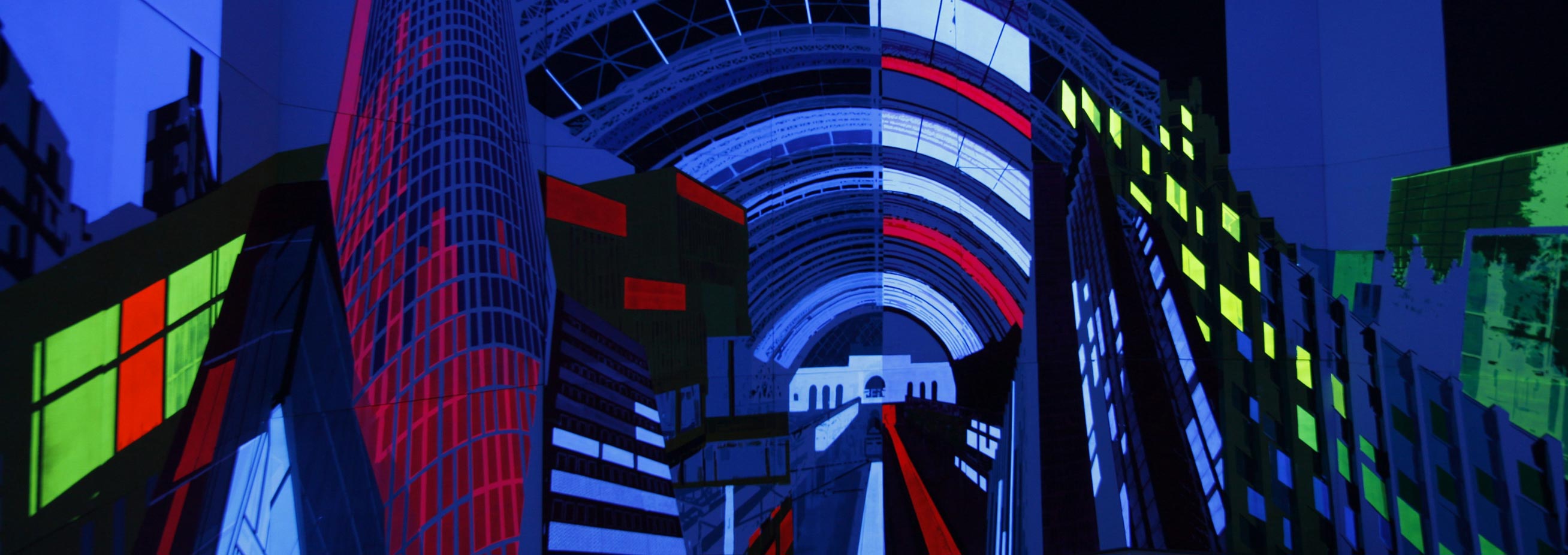 Alma Trtovac – SHIFT
Opening of the exhibition on 15th of April 2014 at 7 pm
April 15 – April 24, 2014
Karas Gallery Praška 4 10000 Zagreb, Croatia“Shift”, a spatial installation art by Alma Trtovac, represents a type of virtual reality walled within an eight-sided chamber by forty-seven acrylic paintings on canvas. As painting translates into architecture, the very act of painting also becomes an act of building, construction and reconstruction.
The author constructs a hybrid urban landscape based on the mental images of two cities – Zagreb and Dresden. As they share the traumatic ordeals of war and destruction, a fluid urban organism emerges from their experiences. The spatial concept of the installation is based on the cycle of life, everlasting change, but also on the permanent repetition of history. The symbolism of the octagonal space is found in the interpretation of a classic Chinese text, I Ching: The Book of Changes, its philosophy being close to the author’s sensibility. The four main walls represent the four sides of the world, but also the four seasons. This newly created city contains within itself the entire world. The subjects of change, the everlasting dynamics of energy and the uninterrupted process are obvious when one approaches the installation – movement and recognizing the vibrating chamber are transformed into a “work in progress”, an experience which repeats itself – each time in a different way. The urban whole remains elusive. The schizophrenic and fragmented character of the contemporary city, the artificially joined pieces of urban tissue appear in flashes and compel us to circle endlessly, repetitively wandering through the neon urban landscape.
The colors of the urban environments react to the UV lights and flash almost aggressively as they are exposed to the lights’ stroboscopic movements. The flickering lights suggest chaos and decay, out of which something new is born. The observer is bombarded with lights, evoking the real traumatic experiences of the two cities. Through her artistic work, the author tries to intimately involve the observer – the experience of the cities becomes our experience, the discomfort one feels stems from participating within the simulated atmosphere.
The lights “train” the observer, who is forced to adapt to the new situation and the newly created urban landscape. Art and space take on an almost Benjaminian role as they become a training ground for new subjects and new psyches. The space forces the observers to adapt to it, but also to seek meaning within it, to critically approach the situation, rather than blindly accepting it.
One can no longer escape to Utopia – art has to maintain alertness and encourage a critical approach. It cannot be seen as “light” in character – rather than comforting us with art for art’s sake, the bright flashes hit us directly and force us to act, to accept the new situation and give in to change.
Resembling Fritz Lang’s scenographic collage, a sort of timeless metropolis is created as the paintings’ frames dissolve within the neon chaos. In this cycle of destruction, a tear appears and out of it emerge the possibilities for change and creation. The universal experiences of pain and war force us to rethink history, to move beyond the trauma through revealing it, much like the ashen hair of Shulamite in the works of Anselm Kiefer. The phoenix city rises from the ash, born anew, strengthened by the experience of individual and collective memory colliding and the healing which results.
Ana Bedenko
Born in Zagreb in 1988. In 2012, received her Master of Fine Arts Degree at the Academy of Fine Arts in Zagreb, under the mentorship of Professor Zoltan Novak.
Working hours: Tuesday – Friday 11 am – 7 pm, Saturday and Sunday 10 am – 2 pm; closed on Mondays and holidays.
10 April 2014
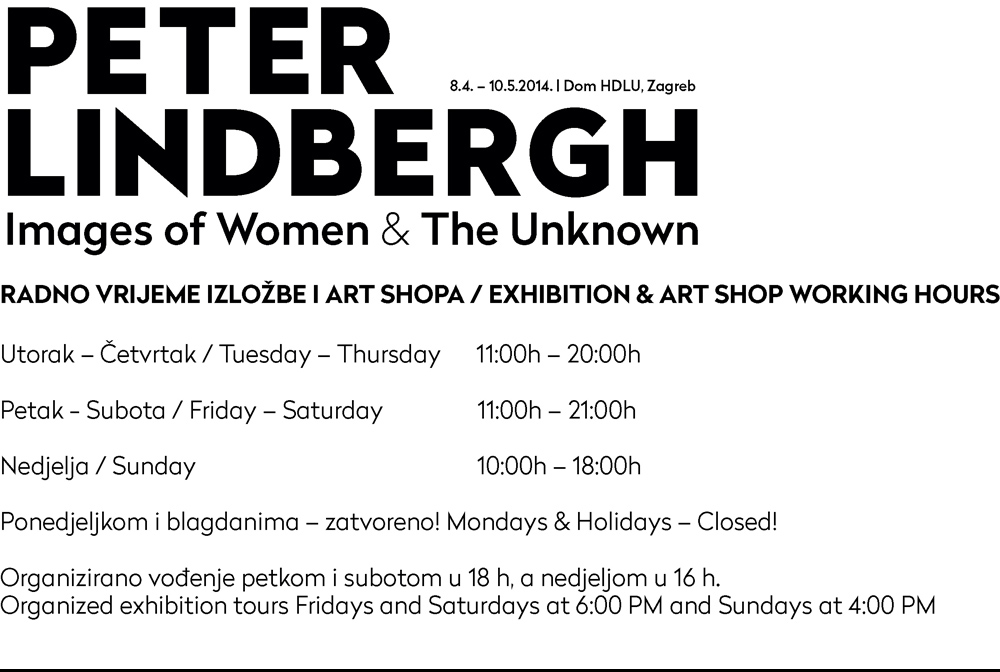
EXHIBITION & ART SHOP WORKING HOURS
Tuesday – Thursday 11:00am – 8:00pm
Friday – Saturday 11:00am – 9:00pm
Sunday 10:00am – 6:00pm
Mondays & Holidays – Closed!
Organized exhibition tours Fridays and Saturdays at 6:00 PM and Sundays at 4:00 PM
PETER LINDBERGH EXHIBITION IN ZAGREB
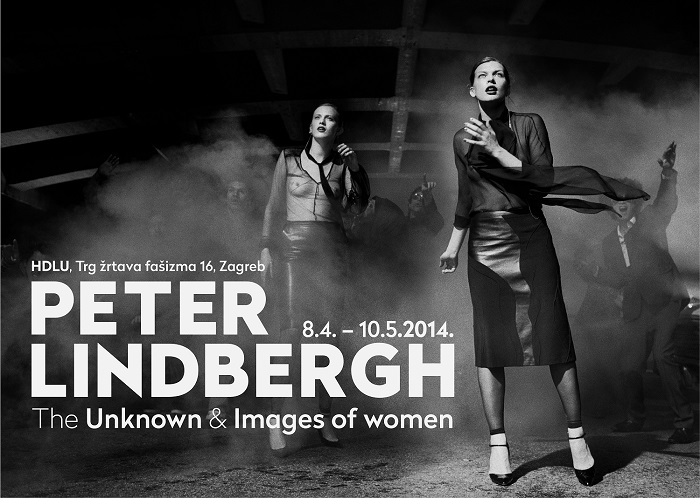
Images of Women & The Unknown is the name of the photo exhibition by renowned photographer Peter Lindbergh
PETER LINDBERGH: Images of Women & The Unknown
April 8th – May 10th, 2014
Gallery HDLU (Trg Zrtava Fasizma 16, Zagreb, Croatia)
————————————————————————————-
Throughout April and May in the Gallery HDLU in Zagreb (Croatia) there will be over 150 photographs on display by renowned photographer Peter Lindbergh, one of the world’s most famous photographers. The displayed works, which Lindbergh will arrange himself in Zagreb, are taken from two of his individual art series Images of Women and The Unknown, which gave the name to the exhibition. This is Lindbergh’s first art exhibition in this region of Europe since 1998, which was displayed in Vienna, and will be one of Lindbergh’s only full exhibitions in Europe this year.
“In Zagreb I will present a selection of work from two series of photographs taken earlier on in my career. These are photographs from the series ‘Images of Woman’, which defined and created a new concept of femininity in the late 80’s and 90’s, while the second component will feature photographs from the ‘The Unknown’ opus in which human beings, the subjects of the photos, are exposed to fears they haven’t met before, in which everything is fictional…” briefly announced Peter Lindbergh about the content of his exhibition in Zagreb.
Even though he is celebrated as one of the world’s most prestigious photographers, to this day this fashion visionary does not fall into the conventional description of photographers. Lindbergh’s start and journey as a photographer truly was different, because unlike many of his colleagues, he didn’t know from the beginning that he wanted to be an artist and a photographer. Instead, Lindbergh’s journey was marked by a variety of odd jobs until he first connected with a photo camera in his thirties. Lindbergh began his career as a photographer in 1971 in Germany during his art studies when he began to work as an assistant to the famous Hans Lux. He soon became independent and moved to Paris where he quickly became a respected and desired photographer because of his creativity and the quality of his work. After his first serious job for French Vogue, editors of the most prestigious fashion and lifestyle magazines around the world as well as the marketing departments of various world-famous cosmetics companies practically began fighting for him and his work to be featured in their editorials, TV, and ad campaigns. He is the recipient of several prestigious awards, including the ‘photographer’s Oscar’ the Lucie Award for his accomplishments in fashion photography. Lindbergh is known primarily for capturing world supermodels and the 1990 black-and-white British Vogue cover with Naomi Campbell, Cindy Crawford, Tatjana Patitz, Christy Turlington, and Linda Evangelista. It is interesting to note that at the start of his career nobody would have imagined that Lindbergh would become one of the most famous, most wanted, and most respected fashion photographers since he never followed certain trends and styles, but focused on what mattered the most to him, which as he says is that ”a woman is always more important than the clothes she wears.”

Peter Lindbergh’s exhibition in Zagreb will be displayed across all of the Home of Croatian Artists spaces – the PM gallery, the PRSTEN gallery, and the BACVA gallery. As well as photographs, one part of the exhibition will feature a video installation which the artist himself, being inspired by the architecture of the gallery, will accommodate exclusively for his Zagreb exhibition! This video component to Lindbergh’s works sets the exhibition in Zagreb apart from his other showings in the past and in the coming years.
———————————————————————————————————————————————–
———————————————————————————————————————————————–
EXHIBITION INFO
Title: PETER LINDBERGH: Images of Women & The Unknown
Date: April 8th – May 10th, 2014
Location: Gallery HDLU
Trg Zrtava Fasizma 16, Zagreb, Croatia (EU)
Organizer: PRiredba studio, Zagreb
Partner: HDLU – Croatian Association of Artists, Zagreb
Press Tour: Sunday 6/4/2014, 11:00
(only for accredited and invited journalists and media representative!)
Opening: Monday 7/4/2014 (invitation only!)
Exhibition opening hours: Tuesday – Thursday 11:00h – 19:00h
Friday and Saturday 11:00h – 21:00h
Sunday 10:00h – 18:00h
Mondays & Holidays CLOSED
Ticket price: Tickets available at the Gallery entrance
Daily adult ticket, 40 kunas
Children under the age of 6 have free entry
Family ticket (4 people) 100 kunas
Group ticker (over 15 people) 25 kunas per person
For PRESS tickets contact press@priredba.hr
For private visits, visits outside of gallery hours, and guided tours, please contact info@priredba.hr
PRESS contact: PRiredba studio
t. (+385) 01 48 47 071
f. (+385) 01 48 47 005
e. press@priredba.hr
#lindberghzg
Photographers: Portrait of the artist: Mart Engelen
Visual display: Peter Lindbergh
Photos of the artist: Peter Lindbergh
27 February 2014
Conference: Doubling Space
Saturday March 8, 10:00 – 19:30
Home of the Croatian Visual Artists, Trg žrtava fašizma 16, 10000 Zagreb
HDLU Club
In conjunction with the exhibition BORROWORROB: in search of symmetry, the HDLU is hosting a conference on the relationship between art, the city, economy, and space. Artists, designers, activists, anthropologists, cultural workers, and lawyers will address these relationships in terms of two interrelated themes: Doubling Space and Space as Asset.
Doubling Space
In many ways, contemporary art practices double and fold the space of the city back into itself. In the late 19th century, Manet’s Bar at the Folies-Bergerè (1882), in which issues of class, gender, spectacle are raised to the surface of a new visibility concurrently through the transformation of painting as a social, commercial, and formal enterprise. What are some of the important contemporary gestures in which space is doubled, folded, and repeated in the urban context through artistic or political practices and what are their effects? How do these practices constitute forms of spatial redistribution and new forms of visibility? What are the historical, economic, social, and political forces of which they are the product? What histories do they seek to establish? To what extent are they distinct from or contribute to global influences reshaping the urban environment?
Space as Asset
On a global level, the financialization of art has created extremely strong markets that have outperformed many others, even during times of financial crisis. From this perspective art operates globally as a form of currency. But there are other forces, organizing practices that are creating new spaces and new economic relations, in which both “practice” is spatially redistributed. As art becomes increasingly developed as a global form of investment, and simultaneously, as the global fair circuit is doubling every few years, mining local cultures and geographic regions for “undervalued” practices and trends, critical contemporary artistic practices are reshaping art as commodity, as asset, or as object. How are these challenges being explored today in Zagreb, regionally in the Balkans, and in what way do the historical forces that have shaped the region point to, away from, or against many of these global systems? What are the spatial assets that art seeks to redistribute, how are they redistributed, and for whom?
Borroworrob: In Search of Symmetry is generously supported by FACE Croatia, The City Office for Education, Culture, and Sport Zagreb, Ministry of Culture of the Republic of Croatia, EPSON, Pozor, AkzoNobel – Dulux, The Sheraton, Urban Stay Zagreb.

Schedule
Space as Asset
10:00- 13:00
Introduction: Peter Macapia
Keynote: Paolo Cirio
Tomislav Tomašević and Teodor Celakoski
Iva Marčetić
Zlatan Krajina
Doubling Space
13:00 – 17:00
Introduction: Peter Macapia
Keynote: Ana Hušman
Sonja Leboš
Bojan Mucko
14-14, Marko Salapura
Conference Keynotes
17:30-19:30
Franklin Boyd
Vito Acconci
Vito Acconci is known for his controversial Body Art of the 1960s and ’70s. Vito Acconci has led a diverse career, one that has taken him from poetry through performance, video work to architecture. In Acconci’s subversive and highly physical performances, the artist was known to bite himself, burn off his body hair, and masturbate under a wooden ramp in a gallery while fantasizing through a loudspeaker about the people walking above him. Acconci’s interest in the human body and its relationship to public space later evolved into architectural, landscape, and furniture design practice and establishing ACCONCI STUDIO based in New York.
Franklin Boyd is a member of the faculty of the Sotheby’s Institute of Art New York. Franklin Boyd lectures on the intersection of Art & Finance, the Art Market and Art Law. Franklin founded Boyd Level, an arts advisory for new collectors, 15 years ago and maintains a private legal practice that focuses on art and entrepreneurial matters. She was recently cited in the United States Copyright Office’s report to the United States Congress on Artist Resale Rights as having developed a model for best practices in the alternative resale rights space. Franklin serves on the board of directors of Art in General (New York) and Zer01 (Silicon Valley).
Ana Hušman, born in Zagreb in 1977. Studied multimedia and art education department graduating in 2002 from the Academy of Fine Arts Zagreb, Croatia. Attended number of Croatian and International festivals and shows. Currently she is working on Academy of Fine Arts, Department of animated film and new media. For her last works she received numerous international awards. Her works has been shown at festivals and exhibitions including; 9th Gwangju Biennale, 53rd Oktobar Salon, Beograd, Medienturm Gallery, Graz; On the Eastern Front, Ludwig Museum of Contemporary Arts, Budapest; “lucy” bodig & ART ON STAGE, URA, Istanbul, Stuttgarter Filmwinter; IFF Rotterdam, 25 fps, Zagreb; DOK, Leipzig, Deutschland.
Sonja Leboš established the Association for Interdisciplinary and Intercultural Research (AIIR) in Zagreb in 2002. Since then she has been working in inter-mediative fields, connecting cultural theory and practice in contexts of different projects, investigating the role of institutions in public and non-governmental sectors as well as vox populi in situ. She has created various interdisciplinary research methods and platforms for articulation of multilayered urban issues and cooperated with different organizations. Some of the on-going projects Sonja Leboš has instigated within AIIR platform: “Cybercine”, (http://www.cybercine.org/); “Mnemosyne-Theatre of Memories”, (http://www.theatreofmemories.eu/); ‘’res urbanae’’, (http://resurbanae.wordpress.com/) and ‘‘aRs PUBLICae’’, (http://1postozaumjetnost.wordpress.com/) .
Bojan Mucko holds a master degree in philosophy, ethnology and cultural anthropology from the Faculty of Humanities and Social Science in Zagreb and is a student of MA program in New Media at the Academy of Fine Arts Zagreb. He has been engaged with urban-anthropological issues, reviewing the disciplinary boundaries between contemporary art practices and cultural anthropology through interdisciplinary projects with several NGOs and organizations such as the Association for Interdisciplinary and Intercultural Research, Shadow Casters, BLOK, Zagreb Society of Architects, Ethnographic Museum Zagreb. He was part of the editorial board of the architecture magazine Man and Space and is part of the organization of the ETNOFILm festival.
Paolo Cirio is an innovative conceptual artist working with various media and domains. He works with the idea of shaping flows of social, political and economic structures, and in doing so explores contemporary systems of control, knowledge and information. Cirio’s work deals with various present issues in fields such as privacy, finance, copyright, democracy, militarism and environmentalism. Cirio’s artworks have been presented and exhibited in major art institutions, including Museum of Contemporary Art, Sydney, 2013; ZKM, Karlsruhe, 2013; CCCB, Barcelona, 2013; CCC Strozzina, Florence, 2013; Museum of Contemporary Art of Denver, 2013; MAK, Vienna, 2013; Architectural Association, London, 2013; Museum of Modern Art, Rio de Janeiro, 2012 and many more.
Dr Zlatan Krajina, Lecturer, University of Zagreb. Zlatan Krajina is the author of “Negotiating the Mediated City” (London and New York, Routledge, 2014). He was awarded MA and PhD in Media and Communications at Goldsmiths, University of London. Previously he worked as a news and documentary producer and presenter. He has worked as an undergraduate lecturer at Goldsmiths, and is currently based at the University of Zagreb, Croatia, where he teaches postgraduate courses on “Media and the City” and “Media Audiences.”
Iva Marčetić holds an MA in architecture from the University of Zagreb’s School of Architecture. As part of Pulska grupa she represented Croatia in the 13th biennial of architecture in Venice. In 2011/2012 she was a fellow at Akademie Schloss Solitude, Stuttgart, Germany and in 2013 she was a resident of Kuda.org from Novi Sad, Serbia. She wrights extensively on housing rights and commodification of land and it’s consequences on city planning and architecture in both post-socialist Yugoslavia as well as Europe. She is a part of editorial team of the magazine “Nepokoreni grad” (Undefeated city) published by the Young antifascist association of Zagreb.
Tomislav Tomašević is currently Ecology Programme Coordinator in Croatian office of Heinrich Bӧll Foundation. He has a BA and MA in Political Science from University of Zagreb, with his dissertation focusing on the critique of a neo-liberal city and an MPhil in sustainable development from the University of Cambridge, in which his dissertation focused on the potential of urban commons. Tomasevic was involved in youth, environmental and urban activism as executive president of Croatian Youth Network, executive president of Friends of the Earth Croatia and co-founder of Right to the City in Zagreb. Tomašević also participated in numerous UN conferences on sustainable development and was Youth Advisor for Europe of United Nations Environment Programme.
Teodor Celakoski is a cultural worker and activist from Zagreb. His work ranges from coordinating cultural programs, networking and cultural advocacy, to institutional innovation and political activism, and is guided by a vision of culture as a form of transformative agency. In the 1990s with a group of friends and colleagues, he established the Multimedia Institute. In 2001 he co-initiated Clubture, the network for exchange of independent cultural programs within Croatia. Teodor played a key role in the establishment of Kultura Nova – public foundation for the development of non-profit independent contemporary culture, and POGON – a hybrid cultural center. He is an active member of the Right to the City alliance, Zagreb.
Peter Macapia is a New York based artist, architect, and theorist. He is a native of Vashon Island in the Pacific Northwest of the US. He is the principal and founder of labDORA. Macapia’s art and architecture focus on the geopolitics of public space, structural engineering, algorithmic computation, and the geometry and topology of matter/energy relations. He has exhibited and performed at The Storefront for Art and Architecture, and internationally at Art Miami/Basel with solo shows in New York, Hong Kong, London, and Los Angeles. He has taught at Columbia University and Sci-Arc, ESA Paris, TUS Tokyo, and TU Delft. Macapia studied at RISD and Harvard and received his PhD from Columbia. He is currently professor at Pratt GAUD.
18 February 2014
Peter Macapia
BORROWORROB: In Search of Symmetry
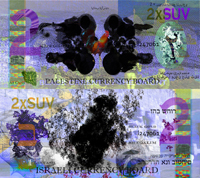
Peter Macapia, Palestinian / Israeli Currency
March 05 – 27, 2014
Opening of the exhibition on March 05, 2014 at 7 pm
Home of the Croatian Artists
Barrel Gallery, Ring Gallery, PM Gallery
Trg žrtava fašizma 16
10000 Zagreb
Working hours:
Wednesday – Friday 11 am – 7 pm
Saturday and Sunday 10 am – 6 pm
Closed on Mondays, Tuesdays and holidays.
Exhibiting: Peter Macapia, Vito Acconci, Paolo Cirio, Einat Amir, Tonči Antunović, Ivan Argote, Fayçal Baghriche, Mladen Stilinović, Ana Hušman, Luciana Lamothe, Peter Rostovsky, Mary Jeys
Projections: Ante Babaja, Charlie Chaplin, Buster Keaton
Borroworrob: In many ways every artistic work is posed in relation to another force. This activity is already spatial. A question borrows space from the space that it questions, but this also robs the space it questions of its own space, sometimes a lot, sometimes just a little – doubling it, turning it inside out – returning symmetry to asymmetry. For this exhibition, Macapia brings together various questions concerning space, including economics, engaged urban research, and history.
In the Barrel Gallery Peter Macapia will present his installation, made in collaboration with students from the Academy of Fine Arts in Zagreb: Jelena Mavrić, Georgette Ponte and Ivona Stražičić. Along with the installation will be a projection of Ante Babaja‘s classic film from 1958, Nesporazum.
PM Gallery now functions as Treasury and Mint, which exhibits and produces world currencies on the geopolitics of space as part of an international call for submissions as well as currency projects by Peter Macapia, Paolo Cirio, Mladen Stilinović, Peter Rostovsky, Mary Jeys and others.
The Ring Gallery presents an exhibition of experimental urban videos by artists from North Africa, Latin America, USA, the Middle East, and Europe including Fayçal Baghriche, Ana Hušman, Einat Amir, Ivan Argote, Luciana Lamothe, Peter Macapia, Tonči Antunović.
It is our great pleasure to announce the premier of The City Inside Me by Vito Acconci, in collaboration with Peter Macapia, especially for this exhibition.
The aim of this project is to engage the audience in questions regarding not only institutions as places but also those forces which define space as space, as a function of other forces, including those that constitute HDLU as many different kinds of institutions, the space between artists and audiences, and the space between them and global art economies, and between global art economies and the doors of the museum and back again . . .
In conjunction with the exhibition Borroworrob, please see the conference Doubling Space. Also in conjunction with the exhibition is the open invitation for the design and exhibition of currency as space: http://borroworrob.org/.
Peter Macapia is a New York based artist, architect, and theorist. He is a native of Vashon Island in the Pacific Northwest of the US. He is the director and founder of labDORA. Macapia’s art and architecture focus on the geopolitics of public space and forms of distributions, structural engineering, algorithmic computation, and the geometry and topology of matter/energy relations. He has exhibited and performed at The Storefront for Art and Architecture, as well as internationally at Art Miami/Basel with solo shows in New York, Hong Kong, London, and Los Angeles. He has taught architectural design, history and theory at Columbia University and Sci‐Arc, as well as ESA Paris, TUS Tokyo, and TU Delft. Macapia studied at RISD and Harvard earning his Bachelor’s and Masters’ degree, and received his PhD from Columbia where he was the recipient of the Presidential Fellowship. He is currently professor at Pratt GAUD.
The exhibition, conference, and currency as space competition is conceived and organized by Macapia with Conference Organizer Danica Selem, and Producer Tonči Antunović, in collaboration with Gaella Gottwald, Director of the HDLU and Sara Čičić, Curator.
For more information contact press@borroworrob.info or galerija@hdlu.hr.
Borroworrob is made possible with the generous support of FACE Croatia, City Office for Education, Culture and Sport Zagreb, Ministry of Culture of the Republic of Croatia, EPSON, The Sheraton and Urban Stay Zagreb Agency.
30 January 2014
Open Call for Papers
Saturday, March 8, Zagreb, Croatia
Conference Keynote Speakers
Vito Acconci, Artist, Designer
Franklin Boyd, Art & Finance Professor; Attorney, Entrepreneur, Collector
Session 1: Doubling Space
Keynote : Ana Hušman, Artis
Sonja Leboš, Artist
Bojan Mucko, Artist, Philosopher, Ethnologist
Selected Presentations: TBA
Session 2: Space as Asset
Keynote: Paolo Cirio, Artist Activist
Zlatan Krajina, Theorist, Goldsmith’s
Iva Marčetić, Architect
Tomislav Tomašević and Teodor Celakoski, Founders Right to the City and Green Action
Selected Presentations: TBA
In conjunction with the exhibition Borroworrob: In Search of Symmetry, Peter Macapia and HDLU are hosting a conference and an open call for papers or performances on the city, currency, and space. The conference is divided into two sessions according to the following themes:
1) Doubling Space: How does one double, repeat, and fold space in the city? How does one expand and reproduce it?
2) Space as Asset: How will art engage emerging and current global economic flows, and how will that engagement effect the city and the logic of space locally and internationally?
Doubling Space
In many ways, contemporary art practices double and fold the space of the city back into itself. This practice has important historical precedents, one of the first of which was Manet’s Bar at the Folies-Bergerè (1882) in which issues of class, gender, and spectacle are raised to the surface of a new visibility concurrently through the transformation of painting as a social, commercial, and formal enterprise. What are some of the important contemporary gestures in which space is doubled, folded, and repeated in the urban context through artistic or political practices and what are their effects? How do these practices constitute forms of spatial redistribution and new forms of visibility? What are the historical, economic, social, and political forces of which they are the product? What histories do they seek to establish? To what extent are they distinct from or contribute to global influences reshaping the urban environment? Authors are encouraged to address these questions from the perspective of their own practices, those of others, as well as from critical, historical, contemporary, geopolitical, socio-economic, anthropological, or other perspectives.

Allora i Calzadilla, Chalk, 1998-2002, Lima ; Francis Alÿs, Sometimes Making Something Leads to Nothing, 1997, Mexico City.
Space as Asset
On a global level, the financialization of art has created robust markets that continue to outperform many other markets, even during times of financial crisis, and quite possibly as a result of crisis. From this perspective art operates globally as a form of currency. But there are other forces organizing art practices that are creating new spaces and new economic relations in which “practice” is spatially redistributed. Already within the recent history of advanced practices groups such as WHW (What, How, and for Whom?) have participated in some of the more groundbreaking tendencies like The Otolith Group, Slavs and Tatars, in which a collective redistributes identity and agency among a group rather than the agenda of a single artist or concept. Similarly, in other instances “economy” is spatially redistributed. Artists like Paolo Cirio use hacking as a means of introducing activism into artistic and aesthetic contexts, reselling assets of other assets and exposing hidden wealth functions of yet further hidden economies. In yet other examples, quasi-institutional practices like E-flux created a time bank in which goods and services are redistributed through a social network and where exchange requires interactions and thus the creation of space.
As art becomes increasingly developed as a global form of investment, and simultaneously, as the global art fair circuit is geographically expanding every year, mining local cultures and for regional trends, critical contemporary artistic practices are continually questioning art as commodity, as asset, and as object. But they are increasingly reshaping the spatial practices and redistributing economic logics that define art as a cultural value. How are these challenges being explored today in Zagreb, regionally in the Balkans, and in what way do the historical forces that have shaped the region point to, away from, or against many of these global systems? What are the spatial assets that art seeks to redistribute, how are they redistributed, and for whom? Contributors are invited to reflect on this theme from the perspective of their own practice, the practice of others, and from historical and philosophical, political, economic, geographical, architectural, psychoanalytic, anthropological, and other points of view.

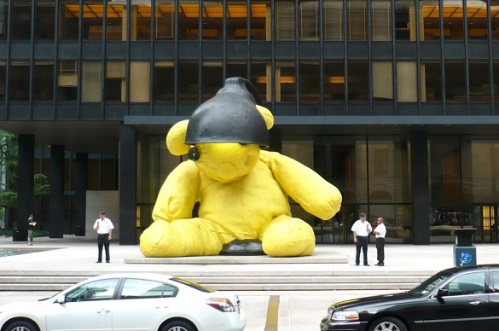
Christie’s Auction Advertisement for Urs Fischer, Untitled (Lamp/Bear), Installed in plaza of Seagram Building: Slavs and Tatars, PrayWay, 2012.
Submission Guidelines
Please submit in English the following in a single page pdf document of no larger than 1 mb:
1) Title of Presentation.
2) Name of author/presenter/or group, email address, and phone number.
3) Abstract of up to 200 words
4) Bio of up to 100 words
5) If you have a website, please include the url.
6) You may include up to one extra page for an image.
For contributors wishing to participate in the session Doubling Space, please send documents to doubling@borroworrob.info
For contributors wishing to participate in the session Space as Asset, please send documents to asset@borroworrob.info
Deadline for Abstracts: February 21, 2014. Selected Presentations will be notified February 23rd.
For contributors wishing to submit a proposal for a slightly different topic or counter-topic, but one still related to the two themes, please send to neither@borroworrob.info
Conference Inquiries: info@borroworrob.info
Press Inquiries: press@borroworrob.info
HDLU Venue: galerija@hdlu.hr
Website for Conference: http://borroworrob.info
The conference is organized by Peter Macapia/labDORA, with Danica Selem and Tonči Antunović for the exhibition Borrroworrob: In Search of Symmetry and in conjunction with the HDLU, http://borroworrob.org/exhibition
Borroworrob is made possible with the generous support of FACE Croatia, City Office for Education, Culture and Sport Zagreb, Ministry of Culture of the Republic of Croatia, EPSON, Academy of Fine Arts in Zagreb, Pozor, AkzoNobel – Dulux, The Sheraton and Urban Stay Zagreb Agency.
Expanded Themes:
Doubling Space
In 1969, Vito Acconci documented a piece in which he followed unknown subjects through the city and wrote down the details of his following on note cards. He did this until they entered a “private” space. Through a very simple act, he doubled the space of the city, folded it, and changed it according to a simple formula. In 2001 Sanja Ivekovic recreated a statue of Luxemburg’s Gëlle Fra as a pregnant “Rosa Luxembourg”, repeating the symbol and the monument folding history back into itself through the space of the city. Susan Lacy’s “Between the Door and Street,” invited feminists to discuss women’s issues on the stoops of a block in Prospect Heights, Brooklyn. Thomas Hirschorn installed the Gramsci Monument in a low-income housing project in the Bronx of New York, which operated as a social local hub for lectures, poetry, newspaper publications, a Gramsci Museum, and a radio station.
Each of these practices constitute different spaces, interventions, scenarios. They rearrange what is always already an experience of the city, of its history, of our relationships, but now have to confront it in an explicitly different way. Through this repetition space becomes a question for the viewer rather than an assumption. In many ways also, this is a particular bind already outlined in Walter Benjamin’s “Author as Producer” – what is the thinnest area between a political content and an aesthetic technique, where do they fold and double up? More contemporary practices, such as Elmgren and Dragset’s When a Country Falls in Love with Itself (2008), introduce a specific problem where narcissism is introduced into the global audience as the irony of their own (global) desires. By contrast, early social political projects, such as Mierle Ukele’s The Social Mirror (1983) taken on the audience of the parade in which irony cannot play such a specific role and the difference between the two critical approaches becomes more pronounced.
Space as Asset
Art spatializes money, deferring or incurring taxes, distributing dividends in art funds, circulating investments, multiplying banking and financial services, encouraging global trade and tourism through the expanding function of fairs, the consolidation of top tier contemporary artists in the auctions, and the simultaneous global rise in art education. Simultaneously, money spatializes art, sends it into storage, puts it on show in a corporate board room, distributes it among collectors participating in funds, moves it from one fair to the next, creates new audiences, and social spaces, turns it into spectacle and distributes it as a radical form of knowledge but which has commodifiable properties. Many practices over the last decade are experiments in economics and financing as a social experiment. These practices introduce obviously counter forces to major market trends, whether real estate development or speculation in the art market. While money and currency are thus not entirely new as critical subjects of inquiry, it is becoming clear that today’s practices (and problems) are dealing no longer with money as an obvious object or system. Indeed, the nature of money as a form of exchange (Marx) and its institutional history (Foucault) point to two of the most consistent, but slightly contradictory understandings. And yet, the evasive nature of exchange value and the critical and historical understanding of money as a means of maintaining asymmetry in power relations seems in fact consistent. From this point of view, one wonders how current and future trends in the definition and use of currency will impact our understanding of spatial relations.
MEŠTROVIĆ PAVILION CLOSED DUE TO RENOVATION
INFORMATION FOR VISITORS


Web Hosting


