
Category: Exhibitions
22 October 2013
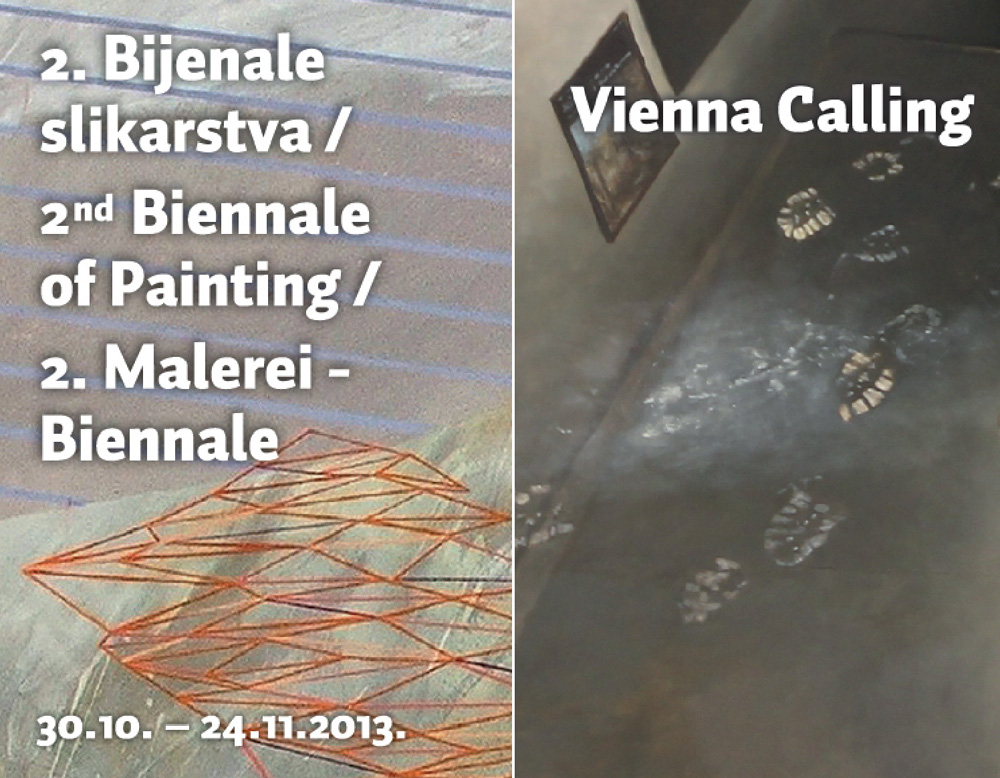
2nd BIENNALE OF PAINTING
30.10. – 24.11.2013.
27 September 2013
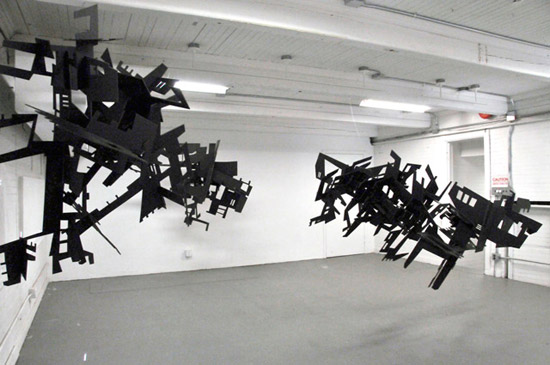 CAITLIN MASLEY
NEO HABITAT
4.10. – 23.10.2013.
Opening of the exhibition will be on October 4th 2013at 7 pm.
Barrel Gallery
Trg žrtava fašizma 16
10000 Zagreb
Opening hours:
Wednesday – Friday 11 am – 7 pm
Saturday and Sunday 10 am – 6 pm
Closed on Mondays, Tuesdays and holidays.
Curator: Branka Benčić
After realization of the wall drawings from the series Marina City ( Marina City #6, galerija 01, Zagreb, 2006) Caitlin Masley returns to Zagreb again, but this time realizing a big site specific installation, architectural/sculptural object, from the series Neo Habitat, designed especially for the Barrel Gallery.
Neo Habitat presents a series of hanging objects – mobiles – architectonic constructions of large formats, hand made of cut and assemblage / collage black poliuretan foam panels, which will fill in the space of the Barrel Gallery with its volume and complex compositions, creating complex spacial hanging / floating structure. On a trail of the ideas of mobile architecture of Yona Friedman, based on a temporary, flexible constructions, aimed to the needs of the population, dynamics of the urban processes, related materials, performance and to the needs of the residential construction in a postwar area.
Caitlin Masley’s Neo Habitat presents visual researches of the organic growth, reconstructing different fragments of the architecture. Its volume overtakes the space of the gallery engaging the senses of the visitor. Detail is multiplied, fragments repeated as kaleidoscopic picture, while in front of our eyes the familiar elements of architecture transform into an abstract construction which spreads in space as an explosion. (From the foreword, Branka Benčić).
Caitlin Masley, has an MFA from the University of Arizona and is currently pursuing a MS in Design and Urban Ecology at Parsons, New York City.. She has won several grants and fellowships, including an Emerging Artist Fellowship from the Socrates Sculpture Park, a Pollock-Krasner Fellowship, Puffin Foundation Grant and Foundation for Contemporary Art (emergency grant) and the LMCC Swing Space Grant and Residency among others. Masley has been artist-in-residence in Austria, Germany, Quebec, Norway and Switzerland. Her work has been included in group exhibitions at MOMA/PS1, Center for Built Environment, Storefront for Art and Architecture. She has created site-specific solo exhibitions at McColl Center for Contemporary Art, Islip Museum, Urban Institute of Contemporary Art and Kingston Museum of Contemporary Art. Upcoming, Masley will install a new site-specific work at MOCA Jacksonville, Florida. Her work is included in the Pfizer Corporate Collection, Benaki Museum, Holt Renfrew, Progressive Corporate Collection and many Private Collections. Caitlin Masley is represented by Lu Magnus Gallery in New York. Currently, she lives and works in Brooklyn.
24 September 2013
 HANA MILETIĆ
SINT-ANNABOS – FOREST SAINTE-ANNE
2.10. – 13.10.2013.
Opening of the exhibition on October 2nd 2013 at 7 pm.
PM GALLERY
Trg žrtava fašizma 16
10000 Zagreb
Working hours
Wednesday – Friday 11 am – 7 pm
Saturday and Sunday 10 am – 6 pm
Closed on Mondays, Tuesdays and holidays.
In this series, Hana Miletić explores and documents the “Sint-Annabos” (“Forest-Sainte-Anne”), a small forest close to the city of Antwerp in Belgium that is threatened by the construction of a highway bridge. Miletić has photographed the trees of the forest in an isolated, individuated way, capturing their shapes in the midst of the night, as if she wanted to make a kind of clandestine portrait of each one of them.
The photographs are printed using the Fresson-technique, a carbon printing technique that was used in the early days of photography. The process involves natural carbon extracted from burned organic material that is deposited on the paper in order to render the picture. Miletić’ photographs of the Forest-Sainte-Anne thus suggest, in a way, a potential for re-incarnation of the trees threatened by abolition. Moreover, the dramatic effect of the Fresson printing technique grants a deep and dark image quality, creating an almost mystical atmosphere inhabiting the photographs.
The selection of photographs presented here does not only document the trees of the Forest-Sainte-Anne in a typological fashion, it also attempts to reinstall a sense of mystery and uncanniness in the experience of the European forest at large: the photographs remind the fact that once, long before modernity disenchanted the forest as a place of leisure and recreation, it was considered an impenetrable place inhabited by wolfs, witches and burglars.
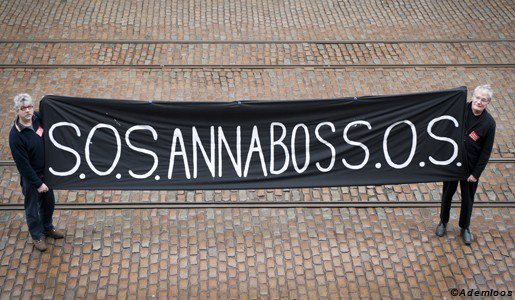
Along with this project of re-enchantment, Miletić also exhibits remnants of the protests by the environmental NGO Ademloos (Breathless) who protests against the destruction of the forest. Their banners and slogans become thus not only politically concerned cries for environmental awareness, but are transformed in objects that call for the preservation and cultivation of zones of secrecy and danger in Europe’s engineered, suburban landscape.
Gawan Fagard


 VANJA TROBIĆ
INNER SPACE OF THE WORLD: LIMBO / TIME CRYSTALS
20.9. – 29.9.2013.
Opening of the exhibition on 20th of September 2013 at 7 pm.
PM GALLERY
Trg žrtava fašizma 16
10000 Zagreb
Opening hours:
Wednesday – Friday 11 am – 7 pm
Saturdays and Sundays 10 am – 6 pm
Closed on Mondays, Tuesdays and holidays.
INNER SPACE OF THE WORLD: LIMBO / TIME CRYSTALS
In her artistic creativity, in which the primary medium is painting, Vanja Trobić discusses the ideological subordination of humans to the material spheres, lack of spirituality, identity development of individuals and society, and the imbalance that occurs as a result of ubiquitous technophilia and alienation from nature. She describes loss in the apocalyptic atmosphere of their own environment, searching constantly for peace in a chaotic world.
The author’s preoccupation is places, spaces, and landscapes in the metaphysical sphere, in which she incorporates awareness, the subconscious, or something on their edge. She is withdrawn in these places, simultaneously drawing us in, showing us reality and what we could be or what we can become. The recognizable and omnipresent dreamy atmosphere of Vanja Trobić’s paintings evokes images of the worlds known to us that we repress just like in a real dreams. Therefore her places are so powerful, strongly metaphorical and moving. The places are inhabited by ghost-like images of animals and people. Children, the symbols of change and regeneration, or – as the author herself called them, a small army of tomorrow, follow us with their empty looks, from canvas to canvas, equal in alienation. Animals are on the other hand the symbols of nature and they function as opposed to the author’s story of the human race. The narrative simplicity of the paintings is an illusion of the invisible and unshown multidimensional meaning which is reflected in visual language of Vanja Trobić, not exhausting it.
The inner space of the world is the author’s mythical place of searching that connects us all. It changes through the pursuit of the humanity and becomes a sphere of new dilemmas. At the same time, it is also a mythical place of return, which is represented by this exhibition as an closed cycle. The exhibition is divided into two poles, which are further broken into several smaller ones. The first pole consists of the triptych “Limbo”, the painting “The place of power” and the portraits “Cosmic Dancers”. The second pole represents the diptych “Visions of the Underworld” and the paintings “Eastern Sky” and “In a Glass House”. The series of drawings and collages “Time Crystals” builds on the entire cycle and closes it by dealing with the theme of time and memory. Every time, this cycle again confirms the originality of thinking in the final version. Regardless of the medium, canvas or paper, the painting and drawing techniques are combined: acrylic, collage, ink-jet transfer and oil. The specific grammar of permeation, constant adjustments and combining, constructing and deconstructing, analysis and synthesis of a different media, creates a visual metaphorical expression that ignores boundaries. The central section shows triptych Limbo metaphor for the spiritual state of modern man whose way of life threatens the nature and life itself (“Fire on the Mountain”). Although by its affiliation inseparable from the community, the individual is alienated (“Living on the riverside”), without the possibility of individual expression, captured by the material imperative and inhibited their ambitions and aspirations (“Overture to the sun”). Limbo represents a mythical place in which we are constantly going back to the origin; it recapitulates our existence, forming itself in that way into a place of the eternal return.
The fragments of memory, presented in a series of watercolor drawings and collages “Time Crystals”, function as debris of social memory, which is inherited from generation to generation as a kind of archetypical heritage. Ancient code of the intimate myths causes nostalgia, but it is about consciousness that is no longer discussed, but simply is itself.
The realization of the author’s thinking embodies itself in the surreal atmosphere of a dream as in a moment before waking, when there is a familiar feeling of tangibility. One can almost reach for the dream act, to reconstruct the story again, to recognize the characters. But the reality is catching up with us, suppressing the subconscious again and winning a world of dreams. Pervading the world of fantasy and reality, the author filters existential questions, that catch our breath like a nightmare, in an innovative way. A melancholic atmosphere and the memory of the inner world still remain recorded, as if the reality on canvas is enchanted by a veil of dream.
Marijana Paula Ferenčić
This exhibition is made possible by the City Office for Education, Culture and Sport Zagreb.
10 September 2013
 Wasser Schöpfen / ZAGRABITI
3.10.13-18.10.13
Opening: Thursday, October 3, 2013, 7pm, HDLU Ring Gallery in Zagreb, Croatia
Featured artists include: Lasse Antonsen (DK), Sebastijan Dračić (HR), Alexandra Evans (US), David Eustace (CA), Candace Goodrich (US), Lætitia Gorsy (FR), Katrin Heichel (DE), Franziska Holstein (DE), Justus Jager (DE), Edgar Leciejewski (DE), Johannes Makolies (DE), Falk Messerschmidt (DE), Pavle Pavlović (HR), Jochen Plogsties (DE) in partnership with Anaïs Goupy (FR), Maria Sainz Rueda (DE), Igor Ruf (HR), Matko Vekić (HR)
One-sided Story artists include: Lasse Antonsen (DK), Jonathan Beer (US), Jason Bereswill (US), Natalia Borčić (HR), Tomislav Buntak (HR), Tania Cross (US), Sebastijan Dračić (HR), David Eustace (CA), Alexandra Evans (US), Fedor Fischer (HR), Sylwia Galon (PL), Céline Germès (FR), Lætitia Gorsy (FR), Jason Sho Green (US), Petra Grozaj (HR), Jane Lafarge Hamill (US), Christi Harrington (US), Jacob Hicks (US), Anna Kiljunen (FI), Anita Kontrec (HR), Karen Lebergott (US), Eric Mavko (US), J. Adam McGalliard (US), Ljiljana Mihaljevic (HR), OKO (HR), Pavle Pavlović (HR), Maja Pejčinović (HR), Igor Ruf (HR), Hilary Schmidt (US), Paulina Semkowicz (PL), Kaitlyn Stubbs (US), Etty Yaniv (IL), Zlatan Vehabović (HR), Matko Vekić (HR), Maeshelle West-Davies (UK), Josip Zanki (HR), Saša Živković (HR)
The group exhibition Wasser Schöpfen/ZAGRABITI is the culmination of The Residency chapter of One-sided Story, www.onesidedstory.com. One-sided Story – The Residency, directed by American artist Candace Goodrich, was a highly successful collaborative project based in Leipzig, Germany from May 2012 to May 2013, involving 38 artists within a year’s time, coming from Denmark, Finland, France, Germany, Poland, Croatia, Israel, the UK, Canada, and the United States. The Croatian Association of Artists and the Alumni Association of the New York Academy of Art were the primary partner organizations. Residents shared a 243 square meter atelier space in Halle 14, www.halle14.org in the Spinnerei www.spinnerei.de, living and working in Leipzig, exhibiting during the Spinnerei Rundgang, as well as in other European cities including Stuttgart, Dresden, Strasbourg, Paris, and New York City. For the occasion of German Reunification Day, October 3rd, and to celebrate Croatia’s entrance into the EU, One-sided Story and the HDLU have also invited special guest artists from Leipzig to exhibit in the HDLU Ring Gallery. All Leipzig artists will be present at the opening.
This exhibition has been made possible by the Ministry of Culture of the Republic of Croatia, the Goethe Institute Zagreb, FDDK e.V., and Ford Motor Vehicles.
27 August 2013
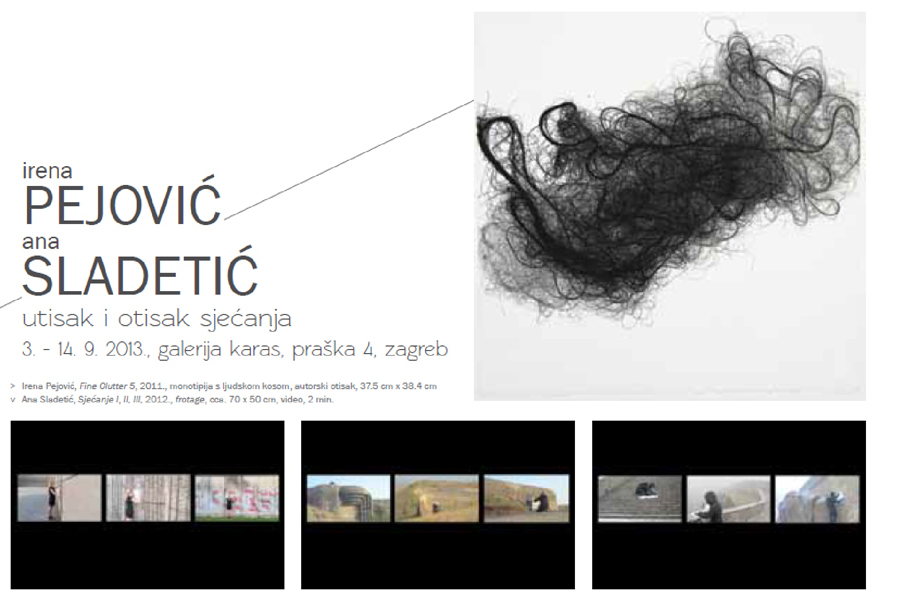 Irena Kojkova Pejović and Ana Sladetić
Memory Between Impression and Imprint
3.9. – 14.9.2013.
Opening of the exhibition on Tuesday, September 3rd 2013 at 8 pm.
CRO
Karas Gallery
Praška 4
10000 Zagreb
Opening hours:
Tuesday – Friday 11 am – 7 pm
Saturday and Sunday 10 am – 2 pm
Closed on Mondays and holidays.
Foreword: Antonia Došen
Baroque ladies, in the spirit of their time, kept their memorabilia in a form of messages on the handkerchief, collected pebbles or shells, hidden in cabinet drawers. Those were the “keepers” of their memory. Just like them, Irena Pejovic and Ana Sladetić, not only preserve their memory, but they present it its material form. But, how can we materialize memory? Ana wants, instead of
taking a picture of a particular place, to bring with her that felt/touchy feeling of the perceived space. She takes the feeling, and imprints it into her “mental closet of memories”. By imprinting the texture of the experienced space, she wants to “touch” her memories. Unlike her, Irena wants to preserve memory in situ (in its present form). This implies to creating the memory on the spot, in the process of printing. By printing two prints at once, one print becomes a memory of the other. By repeating this process, she creates a “fine clutter” of memories – individual experiences from one object to the other. Both artists use ready made materials in their work, with minimal or no intervention on their end. With this, they liberate from eclecticism and tradition, and unfettered push the boundaries of their own observations to part from learned academic form. Here, it’s not important how perfect the imprint is or the form, but the research and the process of making the print.
Ana Sladetić is oriented to preserving the memory in its physical form. She takes its measure. She uses frotage technique (rubbing) to make an impression of the place of visit. In this case, it’s about three walls. Their importance is as much as Ana gives them, the memory of them is limited by her will. Her works, by their reminiscence names Memory I, II and III, consist of video recordings of her performance, taking imprints of the walls in frotage technique. The Great Wall of China, The Berlin Wall and The Atlantic Wall are the carriers of Ana’s concept of imprinting memory. The distorted reality of the wall’s surface becomes a symbol of the same real surface – an abstract mark – Ana manages to preserve her memory in a texture that is rubbed off the walls surface. The imprints act like a cryptogram of her memories, which are read out with the help of visual recordings. Using a wall whose symbolic meaning is bearer of national identity and the real meaning of it is separating space, has no pretentious place in this work, Ana selectively collects memories of the people who created it, leading to the question “How can we preserve memory?”.
The antithetic term for Fine Clutter is about the artist’s personal experience of the materials used, and that creative chaos purified through imprinting it on the paper. In Irena Pejovic’s monotypes, we feel a strong urge for research and innovation, which reflects from the use of a very unconventional material – hair. Polymorphism of the hair enables multiple studies in making of the prints. Working with the human body in her earlier work, Irena attempts to capture its energy and movement by dematerializing the process, which brings her to its abstract form. Here, in a similar way she transforms part of the human body – the hair, preserving its memory in its present form. Looking at how the hair as an object behaves and changes in the process of printing, she pushes it thru several layers, and creates a new perception of the reality when printed. In some of the works, Irena Pejovic uses Chine-collé technique, but only to preserve its memory. She then removes the chine-collé, and this creates a memory of it, a ghost print left on the base paper. By tearing rice paper, and printing two sheets at once simultaneously, she creates a memory of one print to another, resulting in a new moment/object.
Antonia Dosen
This exhibition is realized thanks to the support of the Ministry of Culture of the Republic of Croatia and European Cultural Foundation.
26 August 2013
 Myth and Art / Mitas ir menas / Mit i Art
2.9. – 14.9.2013.
Opening of the exhibition on September 2nd at 7 pm.
Barrel Gallery
Trg žrtava fašizma 16
10000 Zagreb
Opening hours:
Wednesday – Friday 11 am – 7 pm
Saturday and Sunday 10 am – 6 pm
Closed on Mondays, Tuesdays and holidays.
Curators: Giedre Legotaite and Suzana Marjanić
Exhibiting:
Julija Pociūtė
Povilas Ramanauskas
Gabrielė Tamoliūnaitė
Tajči Čekada
Ivan Fijolić
Ksenija Kordić
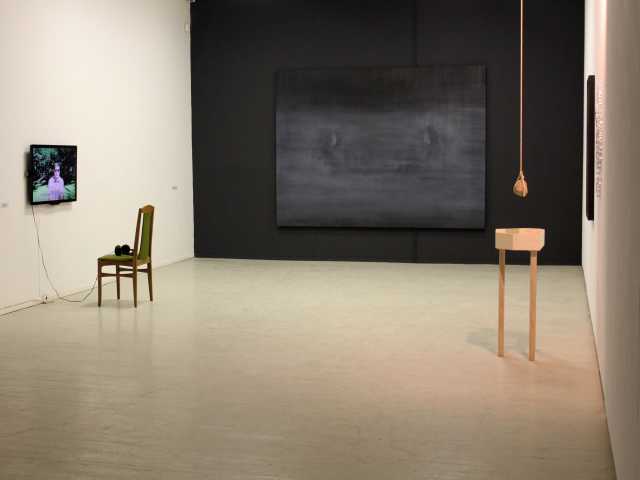
The exhibition Myth and Art is a result of collaboration of the Meno parkas gallery from Kaunas and Croatian Association of Artists, Zagreb. The first exhibition took place in Gallery Meno parkas from 5th of July until the 31st of July 2013. It is a joint exhibition of three young Lithuanian and three young Croatian artists, trying to explore the relation between myth and art with their own unique artistic approach, investigating and explaining the importance of the terms art and myth.
Julija Pociūtė is exploring and analyzing importance of the myth through the eyes of a child. Povilas Ramanauskas is trying to explain the origin of the myth of everything through a dream while Gabrielė Tamoliūnaitė is exploring the the history of the myth through stories about the devil.
Photo performance of the young designer and artist Tajči Čekada, Look into the inter world, is represented as an illustration of the archaic, sacred myth. The works of Ivan Fijolić illustrated the term of ideological myth and Ksenija Kordić’s works illustrated the term of the anarchic myth.
Myth and Art is the exhibition dedicated to the fascinating personality of Mikalojus Konstantinas Čiurlionis (1875-1911), a Lithuanian composer and painter, and his Croatian analogue, Natko Nodilo (1834-1912), historian, politician, publicist and mythologist. And while Čiurlionis tried to achieve interpenetration of painting and music within one artistic medium, in his scientific research Natko Nodilo achieved mutual complementarity of historiography and mythological researches.
The realization of the exhibitions is made possible thanks to support of Lithuanian Culture Support Foundation, Ministry of Culture of the Republic of Lithuania, Kaunas City Municipality, The Ministry of Culture of the Republic of Croatia and City Office for Education, Culture and Sport Zagreb.
MEŠTROVIĆ PAVILION CLOSED DUE TO RENOVATION
INFORMATION FOR VISITORS


Web Hosting


