
Category: Events
23 September 2020
ANĐELA ZANKI
THERE IS NOTHING INSIDE
Karas Gallery, Kralja Zvonimira 58
September 29– October 11, 2020
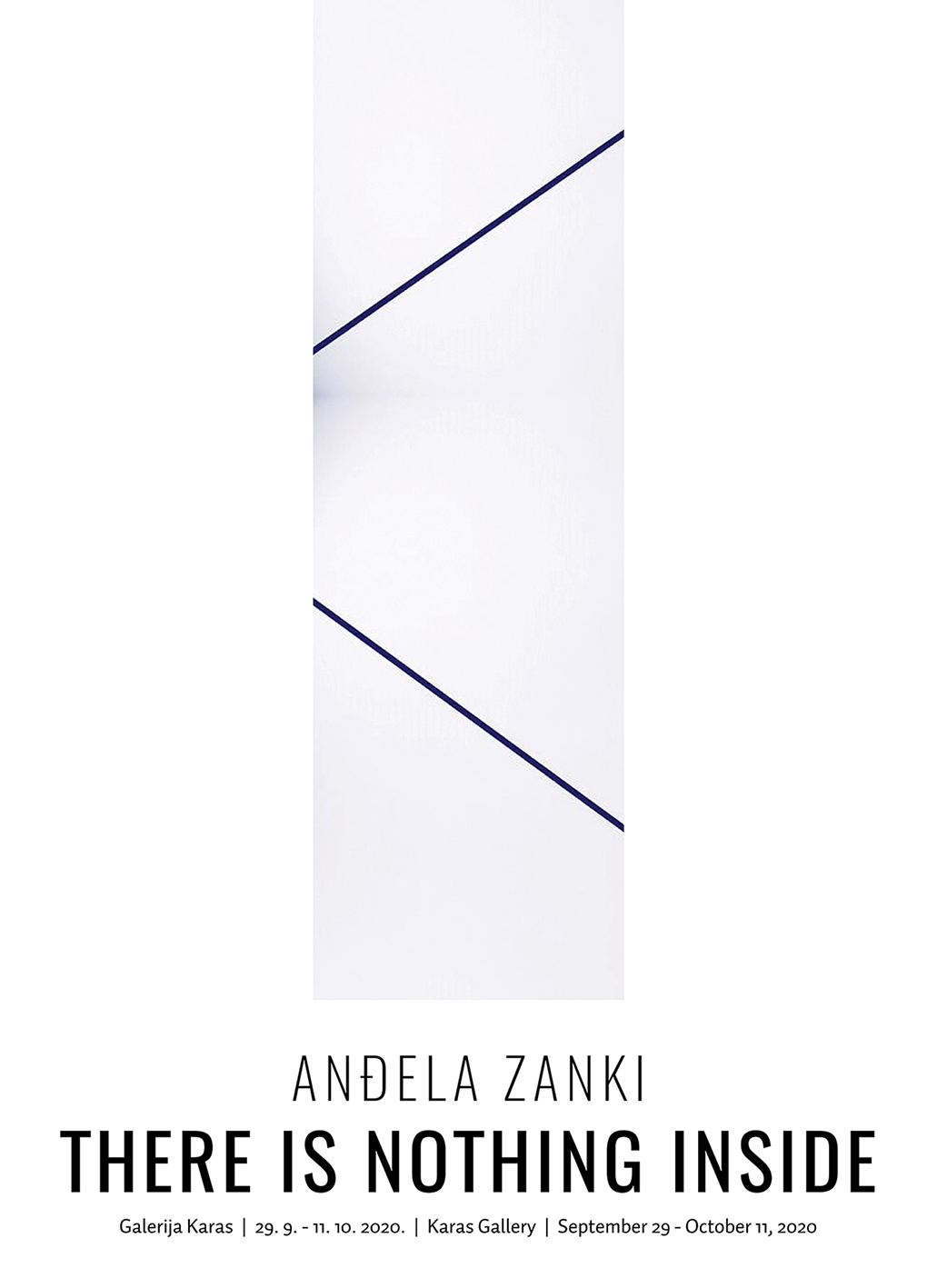
Following all recommendations of the National Civil Protection Headquarters, exhibition THERE IS NOTHING INSIDE, by ANĐELA ZANKI, will be opened on Tuesday, September 29 at 7 pm at the Karas Gallery (Kralja Zvonimira 58).
(…) “The artist focused on questioning the spatial relations and interactions between objects and subjects, invites the viewer to look at himself, inner self, and re-examine its substance, its history, and notions by observing these “empty objects”. How many hidden emotions of happiness, but also fear and worries, did he hide in himself and carry that burden every day? The artworks thus become a copy of ourselves, in an uncertain situation of constant anxiety, they are an illusion of our reality. The illusion of depth collides with the emptiness of these objects, as well as the symbolism of their forms. The circles that “float” and that we first encounter when entering the gallery are a symbol of the spirit, they represent wholeness and homogeneity, perfection without beginning and end. They are also a symbol of the sky (which is also blue), the celestial, and the transcendental. The shape of the circle connects it to the wheel, a symbol of a time that is infinite and eternal. For Jung, the circle is a symbol of the wholeness of the psyche, therefore, a symbol of the self. In the second room, we come across a “broken” square – a symbol of land, foundations, home, security, the four corners of the world, and the four basic elements. Its fragmentation points to the insecurity we face, to the gaps outside and within us that we struggle with, but also to the opportunity to build a “new world” on a better and more mature foundation.
Johannes Kepler said that we need to know geometry in order to understand philosophy because: “Geometry existed before Creation. It is eternal with the mind of God (..) Geometry has offered God a model for Creating (…) Geometry, it is God Himself.”
From preface, written by Nika Šimičić
ABOUT THE ARTIST
Anđela Zanki (1992, Zadar) graduated Painting from the Department of Art Education, Academy of Fine Arts in Zagreb in 2018. She is the winner of the Rector’s Award in 2017 for the project Color to Health at the Rebro Clinical Hospital Center. She has exhibited in several solo exhibitions, of which it is worth mentioning: 2019, Stanja Plave II, Zilik Gallery, Karlovac; 2018, Vibracije, Greta Gallery, Zagreb; 2017, Apsurdom protiv otuđenja (Nikolina Kuzmić, Martin Šatović, Anđela Zanki), Academia Moderna, Zagreb, 201, Mali formati (Marta Tuta, Anđela Zanki), Studio of the Poola Gallery, Pula. She has participated in about forty group exhibitions in Croatia and abroad (2018, Zagrebška akademija – Best Forehand, Equrna Gallery, Ljubljana, Slovenia). She uses minimal expression in her work. She collaborates on international projects (2019, Associate on the project The Leipzig connection, 2017-2018 assistant of the Residential Program in Leipzig, Germany, within the project De/construction of painting, in cooperation with the Croatian Association of Fine Artists and Hafenkombinati; 2015, assisted at the Trešnjevka Cultural Center in the organization of the exhibition Zagreb Ex tempore / international exhibition of ceramics) and art colonies. As part of the project Humanization of Public Spaces through Art Interventions, she is the author of a public work located at the Rebro Clinical Hospital. She is a member of the Croatian Association of Fine Arts artists in Zagreb since 2017. She lives and works in Zagreb.
————————————————————————————————–
Organizer:

Supported by:

Working hours:
Wednesday – Friday: 3 pm – 8 pm | Saturday: 10 am to 1 pm
Sundays, Mondays, Tuesdays and holidays: closed.
The exhibition will remain open until October 11, 2020
*Remark*
At the entrance to the Gallery there is a bottle with a disinfectant for visitors, which are obliged to disinfect their hands when entering the Gallery.
The security guard at the entrance to the Gallery will have a protective mask and gloves and control the number of visitors. The Gallery can hold up to 5 people at a time.
Visitors are required to maintain a distance of 2 meters.
Touching the exhibits is not allowed.
Doorknobs and any other surfaces that are frequently touched by visitors will be regularly disinfected.
PETRA FERIANCOVÁ
SHE WAS UNAWARE OF HER BORDERS. / EGO IN HABITAT.
Curator: Branka Benčić
Bačva Gallery, Home of HDLU
September 24– October 11, 2020

Following all recommendations of the National Civil Protection Headquarters, exhibition SHE WAS UNAWARE OF HER BORDERS. / EGO IN HABITAT., by Petra Feroancová, will be opened in front of the Home of HDLU, on Thursday, September 24 at 7 pm in front of Home of HDLU.
“She Was Unawareof Her Borders (Ego In Habitat), the first solo exhibition of the notedSlovak artist Petra Feriancová in Zagreb is revealed as the artist’s contactwith the space of the Bačva gallery. By placing the works in dialogue with theexhibition space, Petra Feriancová points to the tensions between the space,the observer, and the observed. Her gesture is aimed at questioning spatialrelationships and interactions between objects and subjects, staging theperformative character of the exhibition and moving through space. (…)
(…) Petra Feriancová gathers objects and paintings that she exhibits as a kind of archeology of memory. She deals with, Petra points out, “surviving” objects and the aspiration of objects to expose a part of their own history. Through formal and sensual installations, he deals with objects, in relation to human life, their history, existence, duration, survival, fragility, emphasizing the atmosphere and evoking similar feelings in the viewer. In this way, the artist uses specific visual language to create spaces, memories, catastrophe atmospheres, archeological remains, abandoned humanism, and an encyclopedia formed in the space of experimentation between scientific, historical, and private view, potentiality and imagination, connecting intimate and universal.”
from preface, written by Branka Benčić
ABOUT THE ARTIST
Petra Feriancová is a Slovak artist, writer and curator. She was born in Bratislava, Czechoslovakia in 1977. In 2013, she represented Slovakia and the Czech Republic at the 55th Biennial of Venice. In 2011 she was a resident at ISCP, New York, US, and in 2010, she was awarded the Oskar Cepan Prize for young visual artists organised by the FCS Foundation for a Civil Society.
Selected solo exhibitions include:
Fabvlae, Villa D’Este,Tivoli, IT (2020); Lebenswelt, Significant Other, Vienna, AT (2019); Personale, Gilda Lavia, Rome, IT; Klaviatura, Viltin Gallery, Budapest, HU; I Am Losing My Beauty Together With My Interest in Beautiful Things, Baril, Cluj, RO; Becoming Animal, Tenderpixel, London, UK (all 2018); Systems, Individuals and Measuring Tools, Bòlit Centre d’Art Contemporani, Girona, SP; Survivals, Relicts, Souvenirs, Apoteka, Dignano, Croatia, HR; An Exhibition on Doubt, MAN_Museo d’Arte Provincia di Nuoro, IT; (all 2016); Vulnerable, Yet Everlasting, Viltin Gallery, OFF Biennale Budapest, HU (2015); Things that Happen, and Things that are Done. On Beginnings and Matter, Fondazione Morra Greco, Naples, IT (2014); Still the Same Place, An Order of Things (with Zbynek Baladrán), Czech and Slovak Pavilion, Venice Biennale, IT (2013); A Study of the Secondary Plan, Dumb, The House Of Arts, Brno, CZ (2012); Postsriptum to Childe Harold’s Pilgrimge, Slovak National Gallery, Bratislava, SK (2011) and Theory of a City or the Possibilities of an A4, ISCP, New York, US (2011).
Organizer:
Supported by:

* Supported using public funding by Slovak Arts Council.
WORKING HOURS:
Wednesday – Friday: 11am – 7pm
Saturday and Sunday 10am – 6pm
Mondays, Tuesdays and holidays (May 30): closed.
The exhibition will remain open until October 11, 2020
*Remark*
At the entrance to the Gallery there is a bottle with a disinfectant for visitors, which are obliged to disinfect their hands when entering the Gallery.
The security guard at the entrance to the Gallery will have a protective mask and gloves and control the number of visitors.
Visitors are required to maintain a distance of 2 meters.
Touching the exhibits is not allowed.
Doorknobs and any other surfaces that are frequently touched by visitors will be regularly disinfected.
i.j.PINO
H.Ister.i.ja TouR mitt h*man preselitev 2000 – 2020
Karas Gallery, Kralja Zvonimira 58
September 15– September 27, 2020

Following all recommendations of the National Civil Protection Headquarters, exhibition H.Ister.i.ja TouR mitt h*man preselitev 2000 – 2020, by i.j. PINO, will be opened on Tuesday, September 15 at 7 pm at the Karas Gallery (Kralja Zvonimira 58).
(…) “Uljanik is a brother.
Once you get a job and experience all aspects of working in a collective – everyday, persistent and productive (within the limits of your abilities) you do not need much to realize that your best intentions and efforts do not differ in the slightest from those of your colleagues in any other collective.
In positive things we are all equal, and in negative things we turn into completely different monsters – depending on our imagination, the quality of stomach acid, and the level of moral numbness.
Uljanik is a brother who was killed by monsters.
Unfortunately, he is not the only one, and there are plenty of mortally wounded – unaware of their terminal condition, they walk through Pula like an army of zombies in an invisible apocalypse.
They are not dangerous, but if you look a little closer, they will break your heart.”
From the preface, written by Boris Vincek
ABOUT THE ARTIST
performer, visual artist, musician. He has been known to the alternative cultural scene since the beginning of the seventies when he entered the conceptual and performance circle. At that time he created ‘mental spirit music’ with friends, and under the influence of Beuys, he opened processes for creating so-called ‘social sculpture’, with which he begins to belong a small group of conceptual artists who engaged in questioning socialist value systems, primarily the meaning of work and the position of workers.
i.j.PINO’s position outside the center and his experience as a worker at the Uljanik shipyard secured him the ‘right’ to further radicalization in the field of art. During the eighties, he realized his artistic interests by combining the media of music, performance, and fine arts (alter rock group GustapH y njegovi dobry duhovi, and since the nineties, the public knows him as one of the most provocative Croatian performers, but also as an alternative new media experimenter (telephone concert Netz/Mreža, for Radio ORF).
Proud record holder for attendance at one event/performance (approx. 40,000 visitors, ´Theater like a Life / Life like a Theater or Life is hot pepper…´ Pula / Cro a Ti
All other stupidities can be read in the daily, weekly, and periodical newspapers of this area….
————————————————————————————————–
Exhibition closing event
PERFORMANCE
…GRAN kacata finale, un Gran fumakajo., smo ga pofumali…
26.9. 12PM
Organizer:
Supported by:
Working hours:
Wednesday – Friday: 3 pm – 8 pm | Saturday: 10 am to 1 pm
Sundays, Mondays, Tuesdays and holidays: closed.
The exhibition will remain open until September 27, 2020
*Remark*
At the entrance to the Gallery there is a bottle with a disinfectant for visitors, which are obliged to disinfect their hands when entering the Gallery.
The security guard at the entrance to the Gallery will have a protective mask and gloves and control the number of visitors. The Gallery can hold up to 5 people at a time.
Visitors are required to maintain a distance of 2 meters.
Touching the exhibits is not allowed.
Doorknobs and any other surfaces that are frequently touched by visitors will be regularly disinfected.
28 August 2020
ORGAN VIDA IN KARAS GALLERY
Katarina Juričić – Orange&Blue
3.-13.9.2020.
Karas Gallery | Ul. kralja Zvonimira 58, Zagreb

11.th ORGAN VIDA International festival of photography – Neodlučne slike | 02/09 – 04/10/2020
Katarina Juričić: Orange&Blue
OPENING: 03/09, 18h
“Staring at the Sun and the Sea. The scenery is magical and I feel relieved. The light and the colors nurture my eyes, and the images remain in my mind. Infinite combinations of Orange and Blue, compressed in a memory where reality merges with fantasy.”
In ‘Orange&Blue’, a photographic series which takes the final form as a site-specific installation, I recall a very familiar yet sublime experience of Sunrise and Sunset. Scenes such as the first sun ray of the day or the sunset behind the horizon, are both emotionally and visually profound. As such, they provoke an intuitive reaction to be documented. This results in an overflow of similar photographs in which all the magic of the sublime experience is reduced to an immaterial reproduction of “already seen”.
By taking the iconic imagery of sunrises and sunsets which our memory is loaded with as a reference, I strive to recreate the full range of sunlight colors which we experience throughout the day. Orange and blue light serves as a tool to come as close as possible to the feeling one has when being in the sun and soaking its warmth and color. Throughout the process of re-imagining the iconic imagery, figuration reaches abstraction and all that’s left in the image are light, form and color – ultimately the constitutive elements of any photograph. (Katarina Juričić)
Katarina Juričić (1994, Zagreb) graduated from Journalism at Faculty of Political Science in Zagreb and Photography at Royal Academy of Art (KABK) in The Hague. In her artistic practice, Juričić seeks new forms to embody photography and explore its physicality. She visualizes the imaginary, and therefore unphotographable, aspects of reality such as memories, emotions, visions and hallucinations. She exhibited at Photo Basel in Basel; Unseen Photo Festival, Galerie Ron Mandos and Melkweg Expo in Amsterdam; Galerie Bart in Nijmegen; Nest and Grey Space in The Middle in The Hague; and Rietveld paviljoen in Amesrfoort, among others. Her work is also part of AkzoNobel Art Foundation Collection in Amsterdam.
Working hours:
Wed – Fri: 3 – 8 pm
Sat: 10 am – 13 pm
Wed – Fri: 3 – 8 pm
Sat: 10 am – 13 pm
Exhibition is supported by: Ministry of Culture of the Republic of Croatia, City of Zagreb – City Office for Culture and Stroom Den Haag.
Festival media partners: HINA, British Journal of Photography, Kulturpunkt.hr, Vizkultura, Elle, Super1, Grazia, Vox Feminae, Rplus, H-Alter
24 August 2020
SYMPOSIUM
THE FUTURE OF OUR COLLECTIVE PAST
CLUB HDLU, AUGUST 29, 4 PM
* As part of the exhibition by Behzad Khosravi Noori – Professor Balthazar and a Monument to the Invisible Citizen, which you can see in the Bačva Gallery until September 6, 2020.
Speakers: Boris Buden, Nikica Gilić, Sanja Horvatinčić and Tvrtko Jakovina
The symposium forms part of the exhibition Professor Balthazar and a Monument to The Invisible Citizen by artist Behzad Khosravi Noori. Invited speakers took part in the research process and provided an important insight into local history. Most of their voices are present in the film A Monument to an Invisible Citizen but will also expand their individual research in the symposium.
What are the imaginable alternative futures for our collective past? What might the future reception of our perceptions of the collective past become? What methods of investigation or even interrogation can be used to destabilize the given narrative of the past?
The symposium The Future of our Collective Past addresses aligned forms of historiography within contemporary history in relation to the Non-aligned Movement, memory politics, and histories of the global South. It studies the means of cultural production within the dichotomy of the cold-war situation and beyond and through different historical perspectives, investigates the materiality of contemporary history and the multiplicity of interactions, connections, entanglements and micro-histories embedded in our near past.
Through the re-enactment of material history the symposium casts light on the necessity of artistic practice in relation to how art and artistic research praxis can excavate the image of contemporary history in the present and suggest a possible future for it. The image of our collective past demands reinvention in order to confirm the possibility of thinking about social transformation, emancipation and solidarity.
Schedule:
16:00-16:15 / Introduction (Behzad Khosravi Noori, Ana Kovačić and Lea Vene)
16:15-17:00 / Boris Buden: All what a culture can … is not enough (via Zoom)
17:00-17:45 / Tvrtko Jakovina: NAM (Non-aligned Movement): Yugoslav Heyday in the World’s Largest Political Association
17:45-18:00 / Break
18:00-18:45 / Sanja Horvatinčić: Monumental strategies of the invisible
18:45-19:30 / Nikica Gilić: Zagreb School and its authors in context
19:30-20:30 / Final remarks/comments/Q&A
Organizer:

Supported by:

Sponsors:


Project is produced by Marabouparken in collabration with Malmö konstmuseum and Konstfack.
Exhibition opening hours:
Wednesday: 11-19h; Thursday: 11 am-5pm; Friday: 12-19h; Saturday: 10 am-4pm; Sunday: 11-16h
The gallery is closed on Mondays, Tuesdays and public holidays.
The exhibition remains open until September 6, 2020
Katrin K. Radovani
What. We.Haven’t. Told. You. I. The Red Dress
PM Gallery
July 16 – August 14, 2020
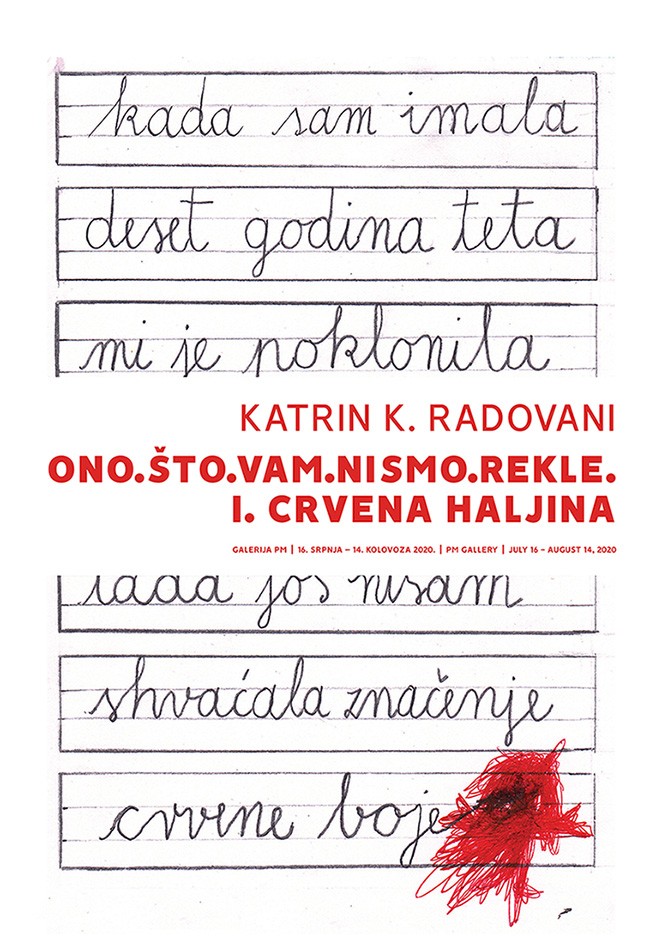
An interdisciplinary project on 5 different cases of childhood sexual abuse divided into 5* acts, based on the real, but untold testimonies.
——————
“What. We. Haven’t. Told. You_I is the continuation of the first sequence of the five-part* work on the topic of trauma caused by sexual abuse (the first sequence was the artist’s eponymous thesis project exhibited and performed at the French Pavilion of the Student Centre in Zagreb, Croatia, in September 2018). With this, also a five-part installation, the artist exposes the space of trauma, visually revealing its layers, stigmas and mechanisms. By dressing the space of the Extended Media Gallery in transparent nylon, she recreates a mental labyrinth that draws the visitor into the very centre of a traumatic experience. This is a multimedia work – it consists of paintings, a site-specific work, sound installation and video that the artist uses to introduce the observer into the work, uttering the text created by studying traumatic experiences. The same, rhythmical and powerful text, makes up the audio installation that activates in different locations around the gallery, overlaps with itself, builds on itself or creates periods of unpleasant silences. At the opening event, the artist gave a performance in which she guided the observes through the spaces of intensity, psychological layers and loops, using a red thread as a guiding line through the underground, repetitive, psychological world of a traumatic experience.
With the work What. We. Haven’t. Told. You_I, Katrin Radovani digs deep into the space of trauma caused by sexual abuse. This topic that is mostly not spoken about, a by-product of patriarchy and stigmatization of women, is still a place of duality in which often the victim, instead of the perpetrator, experiences guilt. Such psychological mechanisms are conditioned by the act of violence, as well as by the centuries-old degradation of women, as the most numerous victims of such power play. Power as a social imperative, appropriation, penetration, violation of another’s physical and mental space, all these are tentacles behind which lie disrespect, non-recognition of otherness as equal, inherent destruction that is the flip side of the society based on domination, with the eternal threat of violence that often affirms the social order. In this sense, sexuality has a special place as a source of life. To penetrate the body, desecrate the source, is a specific expression of pathological domination: often being the victims of abuse themselves, the attackers continue the circle of deprivation, desecration, in an eternal attempt to reach fulfilment, doomed to fail at the very beginning. Thus the trauma is repeated, personally, transgenerationally, almost historically, the force of destruction is maintained, hidden behind institutions, homes, customs and systems.“
From the Foreword by Josipa Bubaš:
* Number 5 is a reference to the Council of Europe’s “One in Five” Campaign that assesses that one in five children at the age of 14 have been sexually abused.
Source: Council of Europe, “One in Five” Campaign, Child and Youth Protection Centre of Zagreb
Katrin K. Radovani biography:
Born in Split, Croatia in 1986. In 2013 she enrolled into the Academy of Fine Arts in Zagreb, Department of Painting. In 2018 she graduated in the class of the Assoc. Prof. Ksenija Turčić with the praise of the Academic Council and earned an MA in Painting. Her thesis project won the first award of the Centre for Women’s Studies as the best student project on the topic of gender and sex issues, as well as the award of the Academic Council. She has won three Rector’s Awards.
In 2017 she won the Venice Summer Academy scholarship for the Art & Performance program, under the mentorship of Prof. Jay Pather. She participated in the final performance marathon of the Curatorial Platform in 2018 and performed “Bolji život“ (“(For) The Better Life“) and “Kabaret identiteta“ (Cabaret of Identities“) at the KNAP centre. She is one of the co-founders of the “CollectiW“ performance collective with which she performed “Sramota!” (“Shame!“) within the Seven Days of Creation Festival in Pazin in 2018 and “Shame!” within the Anima Mundi Festival in Venice in 2019.
She has exhibited in Croatia and abroad, including: Venientes, Šira Gallery (accompanying programme of the 34th Youth Salon), 21st Miniature, ULS, Vršilica, Withdraw – Into the Mountains (within Into the Mountains project), Shed in Eisenwerk, Switzerland, U planinama (Into the Mountains), Bačva Gallery, Croatian Association of Artists – HDLU, 5th Biennial of Painting, Prsten Gallery, Croatian Association of Artists – HDLU, Untitled 5, Baumwolle Spinnerei, Leipzig, Germany and What. We. Haven’t. Told. You. Act I: The Red Dress (solo graduation exhibition), French Pavilion, SC Zagreb in 2019.
In 2019 she completed an internship as the assistant curator to Mark Gisbourne and local coordinator of the exhibition The Leipzig Connection (5th Biennial of Painting, Croatia) and as the assistant on the project of The De/construciton of the Painting art residency, Leipzig, Germany.
In 2020 she as attended the art residency programs of the Creart A.I.R. Kaunas project in Lithuania, Cité Internationale Paris in France and won the Künstler zu Gast in Harburg scholarship in Hamburg, Germany.
WEB: www.kkradovani.com
INSTAGRAM: katrin.k.radovani
Organizer:
Supported by:

Working hours:
Wednesday – Friday: 3 pm – 8 pm | Saturday: 10 am to 1 pm
Sundays, Mondays, Tuesdays and holidays: closed.
The exhibition will remain open until July 19, 2020
*Remark*
At the entrance to the Gallery there is a bottle with a disinfectant for visitors, which are obliged to disinfect their hands when entering the Gallery.
The security guard at the entrance to the Gallery will have a protective mask and gloves and control the number of visitors. The Gallery can hold up to 5 people at a time.
Visitors are required to maintain a distance of 2 meters.
Touching the exhibits is not allowed.
Doorknobs and any other surfaces that are frequently touched by visitors will be regularly disinfected.
ŽELJKO BELJAN
MYTH, EMBROIDERY AND VUTEKS
Karas Gallery, Kralja Zvonimira 58
July 7– July 19, 2020
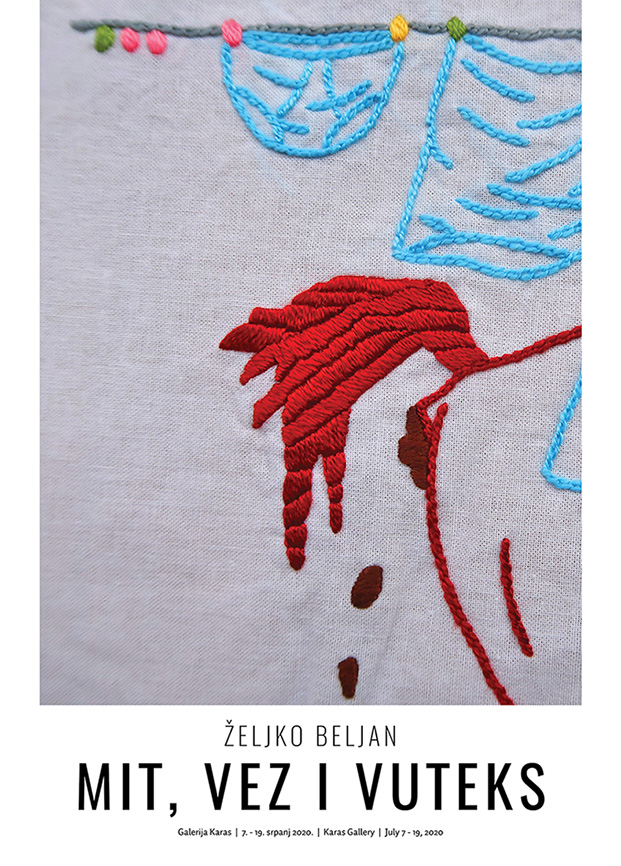
Following all recommendations of the National Civil Protection Headquarters, exhibition MYTH, EMBROIDERY AND VUTEKS, by Željko Beljan, will be opened on Tuesday, July 7 at 7 pm at the Karas Gallery (Kralja Zvonimira 58).
(…) “The embroidery motifs have been changed in Beljan’s alternate reality, they are no longer meant for idyllic kitchens or ethnographic collections in heritage museums, but for the artist’s personal ritual in which he, like a shaman, liberates his own past and changes its course. Just as Saša Božić and Petra Hrašćanec play with the choreographies of folk dance groups in the dance performance Kolo (The Circle Dance) (2019), creating an almost futuristic traditional performance, Željko Beljan also takes us to the psychedelic sky, the same one where we will share a messianic vision with pigs, dolphins, and ducks. In this sky, everything is truly possible in a simultaneous reality. ”
From the preface, written by Josip Zanki
ABOUT THE ARTIST
Željko Beljan was born on June 17, 1984, in Vukovar. Since 2016, he has been studying at the Department of Animated Film and New Media of the Academy of Fine Arts in Zagreb. He has been engaged in illustration, comics, and poster production since 2010. He had his first solo exhibition in 2016 in Osijek. He is the author of numerous posters for various Zagreb clubs and other artistic initiatives and bands of which he is a member or associate.
Organizer:
Supported by:
Working hours:
Wednesday – Friday: 3 pm – 8 pm | Saturday: 10 am to 1 pm
Sundays, Mondays, Tuesdays and holidays: closed.
The exhibition will remain open until July 19, 2020
*Remark*
At the entrance to the Gallery there is a bottle with a disinfectant for visitors, which are obliged to disinfect their hands when entering the Gallery.
The security guard at the entrance to the Gallery will have a protective mask and gloves and control the number of visitors. The Gallery can hold up to 5 people at a time.
Visitors are required to maintain a distance of 2 meters.
Touching the exhibits is not allowed.
Doorknobs and any other surfaces that are frequently touched by visitors will be regularly disinfected.
MEŠTROVIĆ PAVILION CLOSED DUE TO RENOVATION
INFORMATION FOR VISITORS


Web Hosting


