
Category: Events
Dear vistors,
The Croatian Association of Fine Artists (HDLU) is temporarily closed due to COVID-19 pandemic.
All of the communication and working with clients is further possible by email and phone. You can find contacts of our employees on HDLU Website. For all the necessary information you can contact: tajnistvo@hdlu.hr or phone: + 385 14611 818.
We look forward to welcoming our visitors back to the all of our galleries as soon as it is possible again.

04 March 2020
VLATKA ŠKORO
PACK
Bačva Gallery, Home of HDLU
March 10 – March 22, 2020

Exhibition Pack, by Vlatka Škoro, will be opened on Tuesday, March 10 at 6 pm at the Karas Gallery (Zvonimirova 58).
“Pack, created by the sculptor Vlatka Škoro, is a group of 12 new sculptures of the African wild dog conceptually gathered around the Alpha, the sculpture of the African wild dog from the growing Animal series of works (2019) exhibited last year in Zagreb and, in an expanded form, in Osijek. Pack is a continuation, that is, a kind of extension of the above-mentioned series. (…)
(…) The theriomorphism of the Animals gains a new dimension with the Pack due to the significant choice of the motif of an animal that is completely unfamiliar with human presence, even finds it impossible. The animal’s organic structure is an imperative for Vlatka Škoro, for her meticulous approach to the subject, the same as her instinct that she follows both in the choice of motifs and in creating the sculpture itself. The naturalism of the Pack, manifested in the fluidity of natural (that is, sculptural) forms and character of sculptures, contrasted to the neutral backdrop of the gallery space, is further emphasized. By contrasting the wilderness with the aesthetics of the civilized world and analytical deconstruction of structures, Vlatka Škoro gives us an insight into her own sculptural truth.”
From preface, written by Ivan Roth
ABOUT THE ARTIST
Vlatka Škoro (1987, Osijek) lives and works in Zagreb. In 2010 she received an M.A. in Sculpture from the Academy of Fine Arts in Zagreb, in the class of the professor Stjepan Gračan. In 2018 she earned her PhD in Sculpture from the Academy of Fine Arts. She won the Erste Grand Prix Award (2010). She has exhibited in six solo and about twenty group exhibitions in Zagreb, Osijek, Rijeka, Split, Vinkovci, Đakovo, etc.
Organizer:

Supported by:

Sponsors:


WORKING HOURS:
Wednesday – Friday: 11am – 7pm
Saturday and Sunday 10am – 6pm
The exhibition will remain open until March 22, 2020
Croatian Association of Fine Artists in collaboration with the Ministry of Veterans’ Affairs conducts an international visual arts competition The Victim of Vukovar 1991.
The aim of the international visual arts competition The Victim of Vukovar 1991 is to establish a dialogue with contemporary art practices based on the culture of memory and symbolism of war suffering of the city of Vukovar and generate artworks that will be inscribed in the collective memory.
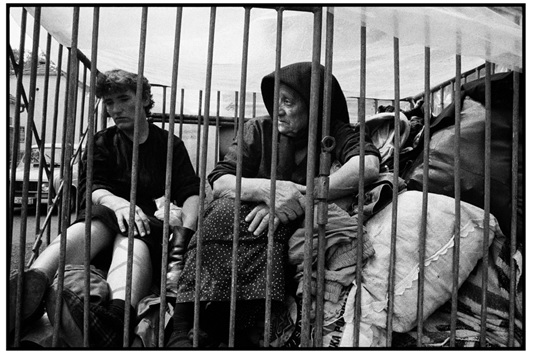 Photography: Zoran Filipović Zoro
The competition will select four new works of art (that have never been presented to the public) to be exhibited in Zagreb in June 2020, on the occasion of the Croatian presidency of the Council of the European Union, after which the exhibition will be held at the Vukovar Municipal Museum until the end of 2020.
The selected artists will receive an artist’s fee of HRK 60,000 gross each. Artists will be provided with return transport of the artworks, insurance, and overnight and travel expenses for participation in the exhibitions.
Competition is open to professional artists, EU Member States citizens, working in the field of visual arts. Artists can apply individually, in pairs or as a part of an art collective. Deadline for submission is 9.4.2020.
Works will be selected by a jury consisting of: Tonko Maroević, academician, Branko Franceschi, art historian, Kristijan Milić, film director, Božica Dea Matasić, full professor of arts, Tomislav Buntak, associate professor of arts, Ana Holjevac Tuković, PhD in History, Mirela Buterin, LLB.
More details on the competition is available HERE.
Questions and answers for the INTERNATIONAL VISUAL ARTS COMPETITION “THE VICTIM OF VUKOVAR 1991 HERE
NOTICE OF TEMPORARY SUSPENSION
of the International Visual Arts Competition
“The Victim of Vukovar 1991“
Due to changes in the economic trends in the Republic of Croatia as a result of the COVID-19 epidemic which have led to the reallocation of funds to measures and activities aimed at combating the epidemic, as well as to changes in the planned budgetary activities to optimize the use of limited fiscal potential, the Ministry of Defence (The Client) has adopted the decision to temporarily suspend the International Visual Arts Competition “The Victim of Vukovar 1991“.
All the competition activities have been postponed until further notice, that is until the funds have been secured and the decision has been made to continue with the competition, about which all the artists who applied to the competition will be notified in a timely manner.
Artists who wish to withdraw their applications due to changes in the competition conditions can do so by sending an email to hdlu@hdlu.hr with the subject Vukovar Competition – Application Withdrawal.
Thank you for your understanding.
02 March 2020
PETAR KATAVIĆ
ARCHITECTURE
Karas Gallery
March 9 – March 22, 2020
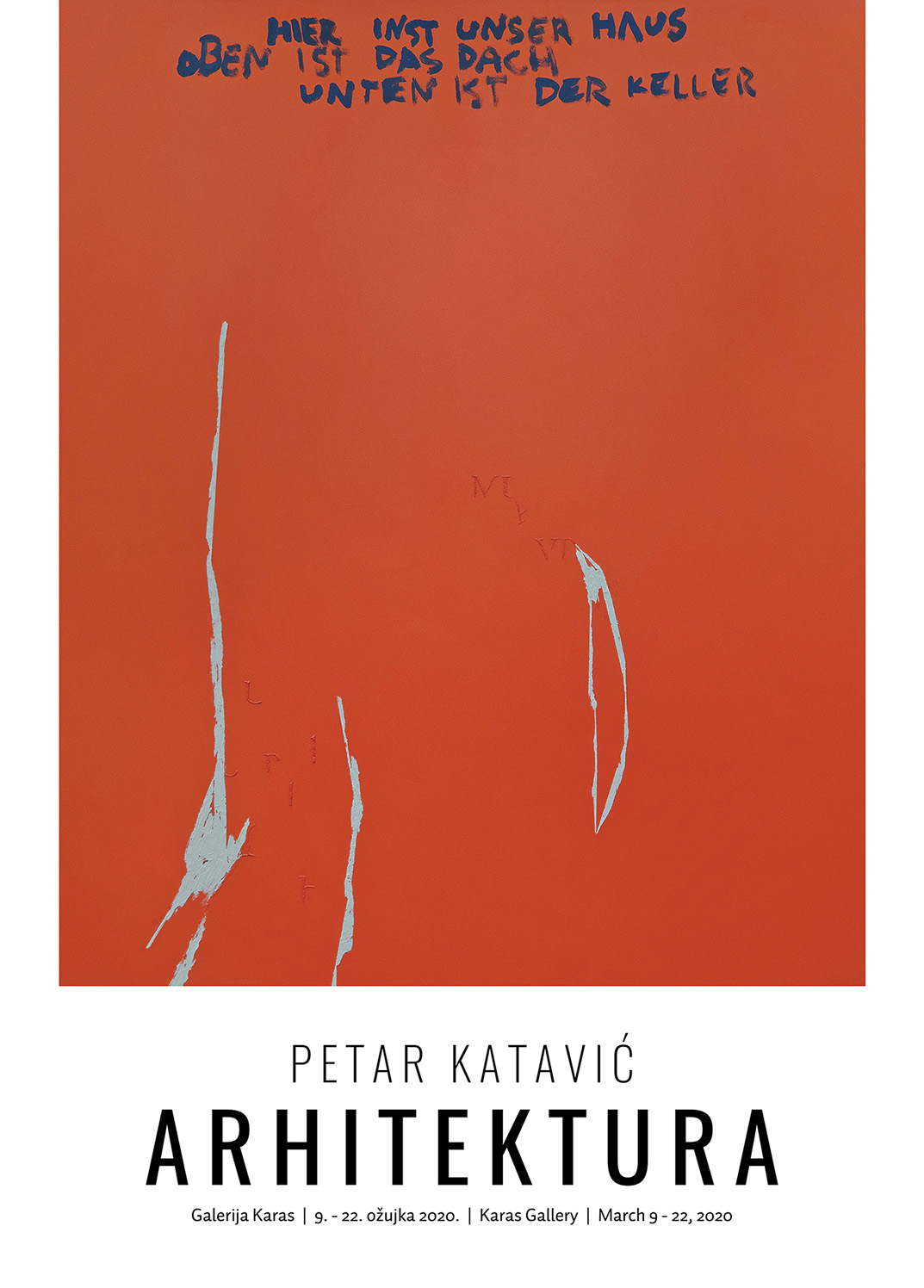
Exhibition Architecture, by Petar Katavić, will be opened on Monday, March 9 at 7 pm at the Karas Gallery (Zvonimirova 58).
“The exhibition presents the work of Petar Katavić, and here selected works are the continuation of the exhibition held at the Museum of Fine Arts in January this year. Since 2017 Petar has been developing and building on his ideas about shaping space with volume, which he also strives to show through his works. The reduction of colour, lines and surfaces, as well as simplicity in thinking about visual art, are the characteristics of the artist’s work, reflected both in the titles of his works and in the exhibition set-up. The exhibition held at the Museum of Fine Arts was titled Space, mostly because it was a site-specific exhibition creating bearing in mind the specific exhibition space within the gallery, and the title of this exhibition – Architecture – is a logical continuation that reveals the focus of the artist’s interests. (…)
(…) Although the aesthetics of Petar’s works is reduced, minimalistic and simple, each work reflects his dedication and devotion, which he sees as the most important factor in his work. In conclusion, I will again, just as in the preface to the Space exhibition, refer to Mies van der Rohe’s famous motto “less is more“, Petar’s guiding principle that very clearly illustrates the subtlety and meditativeness that I find in Petar’s works.”
From preface, written by Ivana Vukušić
ABOUT THE ARTIST
Petar Katavić was born in Split in 1985. In 2005 he graduated Painting at the School of Fine Arts, Split, Croatia. In 2012. he graduated Painting from the Arts Academy, University of Split, Split, Croatia. In 2014 he completed the program of pedagogical-psychological-didactic-methodical education at the Faculty of Humanities and Social Sciences, University of Split, Split, Croatia. He had solo exhibitions in SC Gallery, Zagreb (Surface, 2020), Salon Galić Gallery, Split, Croatia (2019), Museum of Fine Arts, Split, Croatia (2019), Branislav Dešković Gallery of fine arts, Bol, island of Brač, Croatia (2018), Studio 21 Gallery, Split, Croatia (2015), Salon Galić Gallery, Split, Croatia (2014), Museum of Fine Arts, Split, Croatia (2012), and Loggia / Center for Culture and Lifelong Learning ‘Golden Gate’, Split, Croatia (2012). He has also participated in numerous group exhibitions. Note worthily are: Golden watermelon 3,0. Pula, Croatia (2019), 54th Zagreb Salon, Zagreb, Croatia (2019), 40th Split Salon, Split, Croatia (2018), Museum of Fine Arts, Split, Croatia (2017) and 39th Split Salon, Split, Croatia (2015). He is currently an assistant professor in the Department of Painting at the Arts Academy, University of Split.
Organizer:
Supported by:
Working hours:
Wednesday – Friday: 3 pm – 8 pm | Saturday: 10 am to 1 pm
Sundays, Mondays, Tuesdays and holidays: closed.
The exhibition will remain open until March 22, 2020
04 February 2020
MARGARETA LEKIĆ
THE RUBBER CONCRETE
Karas Gallery
February 11 – February 23, 2020
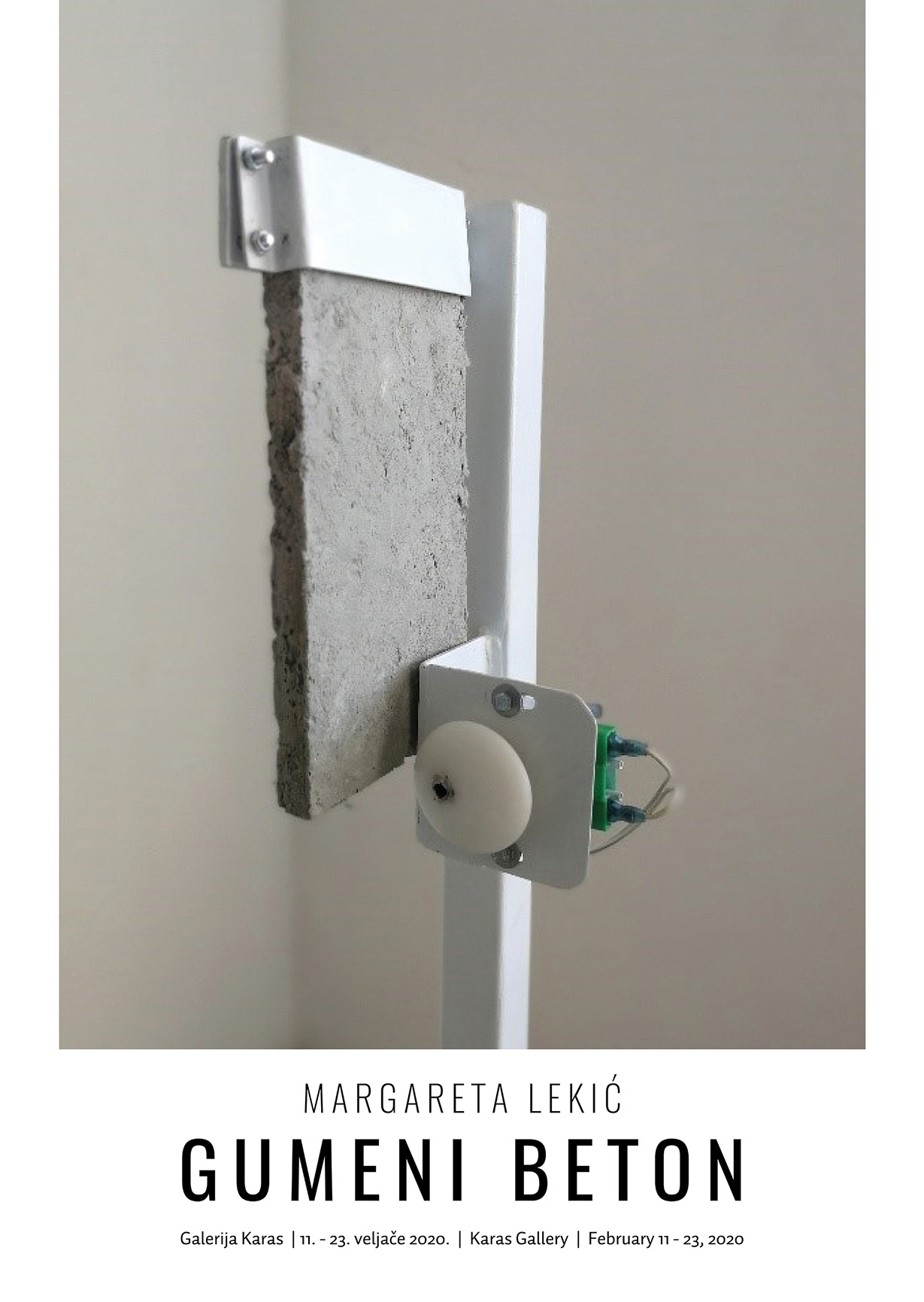
Exhibition The Rubber Concrete, by Margareta Lekić, will be opened on Tuesday, February 11 at 7 pm at the Karas Gallery (Zvonimirova 58). Exhibition is also the public presentation of the artistic part of the doctoral thesis “Redefining Sculpture Using Contemporary Materials” at the Postgraduate Study of the Academy of Fine Arts, University of Zagreb.
Mentors: Prof. Damir Matausic and Ph.D. Margareta Turkalj Podmanicki.
ARTIST STATEMENT
The development of technology and the desire to create new products also result in the creation of new materials. The Gumeni beton (Rubber Concrete) series of works and the new eponymous material were created as a reaction to the inability to access new and innovative solutions in the material manufacturing industry. Searching for an unusually flexible material, I came across a concrete called ConFlexPave, which is rubber under pressure but is not flexible to the extent that it can be restored to its original shape. Since ConFlexPave is not commercially available, I contacted Nanyang Technological University (NTU Singapore), that is, NTU-JTC Industrial Infrastructure Innovation Centre (I³C) to obtain a sample of the concrete for the purposes of my artistic research. I did not get a reply, so I decided to create a new type of material myself, without having any scientific knowledge and expensive laboratory equipment. I created concrete that is rubber in both directions when pressed with hands. However, since I am not a scientist and the material has not been tested in the conditions under which materials are usually tested, I cannot conclude whether this material, a rubber concrete, will be equally flexible even after a certain amount of time has passed. The newly created material, that is, the new type of concrete, has all the characteristics of concrete as a composite material, it consists of cement, gravel, sand, water and additional components that make it flexible.
The Rubber Concrete series of works consists of three sculptures titled Rubber Concrete 1, Rubber Concrete 2 and Rubber Concrete 3. I use the word “rubber” because in everyday language it is common to say that anything flexible is like made of rubber, for example, a physically flexible person is often referred to as “a rubber man“. Therefore, the word “rubber“ in the work’s title does not refer to the physical structure but has a figurative meaning. All three sculptures are in equal proportions, in the correct size ratio. This structure, i.e. the order and correlation in the Rubber Concrete series of works is obvious because all three sculptures are placed in a certain ratio to each other; Rubber Concrete 1 is approximately 40% higher than Rubber Concrete 2, and Rubber Concrete 2 is 40% higher than Rubber Concrete 3. In doing so, I created a proportional relationship, not only between the dimensions of the sculptures but also between the dimensions of concrete slabs. The concrete slab in the work Rubber Concrete 1 is 40% longer and wider than the slab in the work Rubber Concrete 2, and the slab in the work Rubber Concrete 2 is 40% longer and wider than the slab in the work Rubber Concrete 3.
Rubber Concrete 1
– concrete slate: 25x12x1 cm
– sculpture: 140x40x40 cm
Rubber Concrete 2
– concrete slate: 35x17x1,5 cm
– sculpture: 98x48x40 cm
Rubber Concrete 3
– concrete slate: 45x24x2 cm
– sculpture: 70x55x40 cm
Accordingly, a calculation can be made:
SCULPTURE – height extension (h) by 40%
The second sculpture was extended by 40% over the third, i.e.:
h_2=h_3+0.4h_3
h_2=1.4h_3.
Since the first sculpture is 40% higher than the second, the following formula will apply:
h_1=h_2+0.4h_2
h_1=1.4h_2
h_1=1.4∙1.4h_3
h_1=〖1.4〗^2 h_3.
If there were n number of sculptures, formulas to associate their heights with the height of the nth sculpture would read:
h_(n-m) =〖1.4〗^m h_n,
where n is the maximum number of sculptures and m is a growing number of natural numbers.
In particular, if we applied the last mentioned formula to the dimensions of the sculptures in the artwork, it would be:
→for n=3, m=1: h_(3-1)=〖1.4〗^1∙h_3
h_2=1.4∙h_3
h_2=1.4∙70 cm
h_2=98 cm
which is the length of the height of the other sculpture.
The same would be true of the first sculpture as well:
→for n=3, m=2: h_(3-2)=〖1.4〗^2∙h_3
h_1=〖1.4〗^2∙h_3
h_1=〖1.4〗^2∙70 cm
h_2=137.2 cm ≈140 cm
CONCRETE SLABS – height extension by 40% and width extension by 40%
If x denotes the lengths and y the widths of the slabs, then for the 2nd concrete slab which is in relation
to the first one longer by 40% the following formula will apply: x_2=x_1+0.4x_1
x_2=1.4x_1.
For the third slab, which is 40% longer than the second, the following would be true:
x_3=x_2+0.4x_2
x_3=1.4x_2
x_3=1.4∙1.4x_1
x_3=〖1.4〗^2 x_1.
In general: x_n=〖1.4〗^(n-1) x_1,
where n is the number of the concrete slab and x_n the corresponding length of the same slab.
A similar consideration can be applied to the widths of the slabs which we will denote by y, and so for these dimensions a following formula would apply: y_n=〖1.4〗^(n-1) y_1, where n is the number of the concrete slab and y_n the corresponding width of the same slab.
Applying formula to the specified dimensions of concrete slabs in the artwork, we get the following: →for n=2: 〖 x〗_2=1.4∙25 cm=35 cm
〖 y〗_2=1.4∙12 cm=16.8 cm ≈17 cm
→for n=3: 〖 x〗_3=〖1.4〗^2∙25 cm=49 cm
y_3=〖1.4〗^2∙12 cm=23.52 cm ≈24 cm.
ABOUT THE ARTIST
Margareta Lekić was born in Osijek in 1982. She is a member of the Croatian Association of Artists – Osijek and Croatian Association of Artists – Zagreb. She graduated from the Department of Sculpture at the Academy of Fine Arts in Zagreb, where she is currently pursuing her doctoral studies at the same department. She works as an artistic associate at the Academy of Arts and Culture in Osijek. She has won numerous awards and grants. She has studied in the USA, Austria and France. Since 2005 she has had 22 solo exhibitions and has participated in 55 group exhibitions. Margareta has exhibited in Croatia, Europe, the USA, Japan and China.
Organizers:

Supported by:
Working hours:
Wednesday – Friday: 3 pm – 8 pm | Saturday: 10 am to 1 pm
Sundays, Mondays, Tuesdays and holidays: closed.
The exhibition will remain open until February 23, 2020
30 January 2020
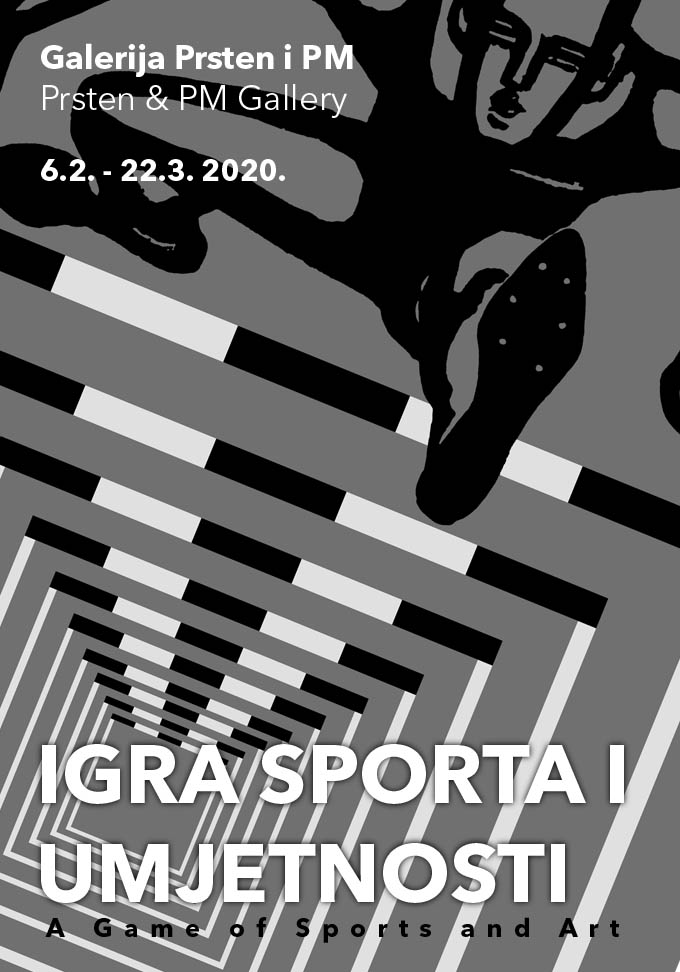
A Game of Sports and Art – Towards a permanent exhibition of the Croatian Sports Museum
February 6 – March 22
PM and Prsten Gallery
Home of HDLU
Opening: Thursday, February 6, 2020
The Croatian Sports Museum, in collaboration with the Croatian Association of Artists and the Academy of Fine Arts from Zagreb, presents a comprehensive exhibition project titled A Game of Sports and Art that announces the permanent exhibition of the Croatian Sports Museum.
Through the exhibition in two parts, the Home of the Croatian Association of Artists becomes a meeting place for sports, education, culture and art, which testifies to the connection between art and sports.
The first part of the exhibition shows the development of applied arts in the field of sports since the beginning of organized sports in Croatia, whereas the second part of the exhibition presents sports as a profession and widespread healthy recreational activity, as well as inspiration for the creation of artworks by contemporary artists.
The exhibition features a wide range of exhibits – from museum ones, which combine traces of history and tell the story of the development of sports, to artworks that comment, describe personal experiences and speak of the possible combinations between various creative sports games and art.
MEŠTROVIĆ PAVILION CLOSED DUE TO RENOVATION
INFORMATION FOR VISITORS


Web Hosting


